

The latest news on business and economy
Provided by AGP
Smart Air Conditioners Market to Reach USD $34.78 Billion by 2030 at 11.1% CAGR
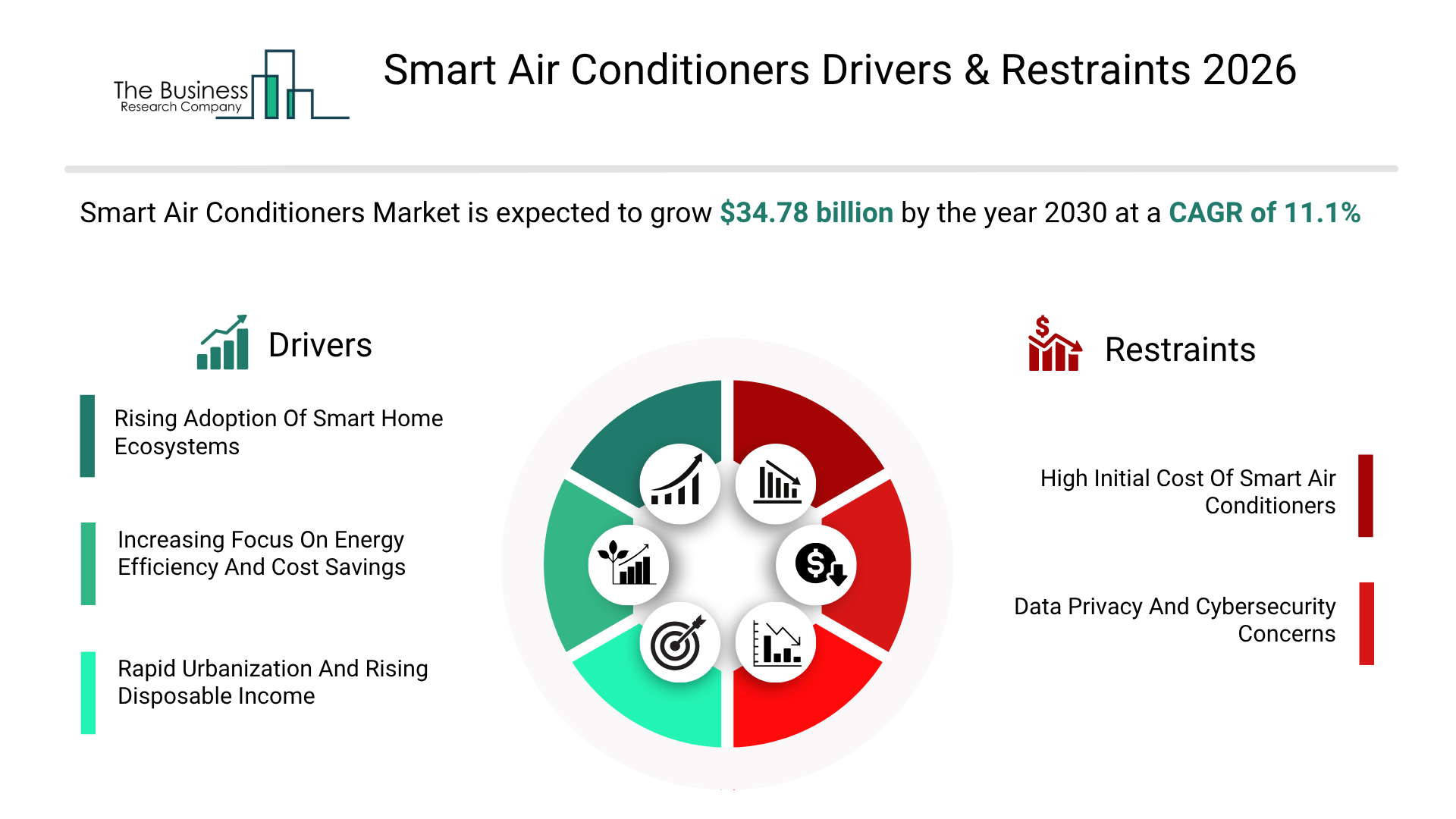
Smart Air Conditioners Market Growth Forecast
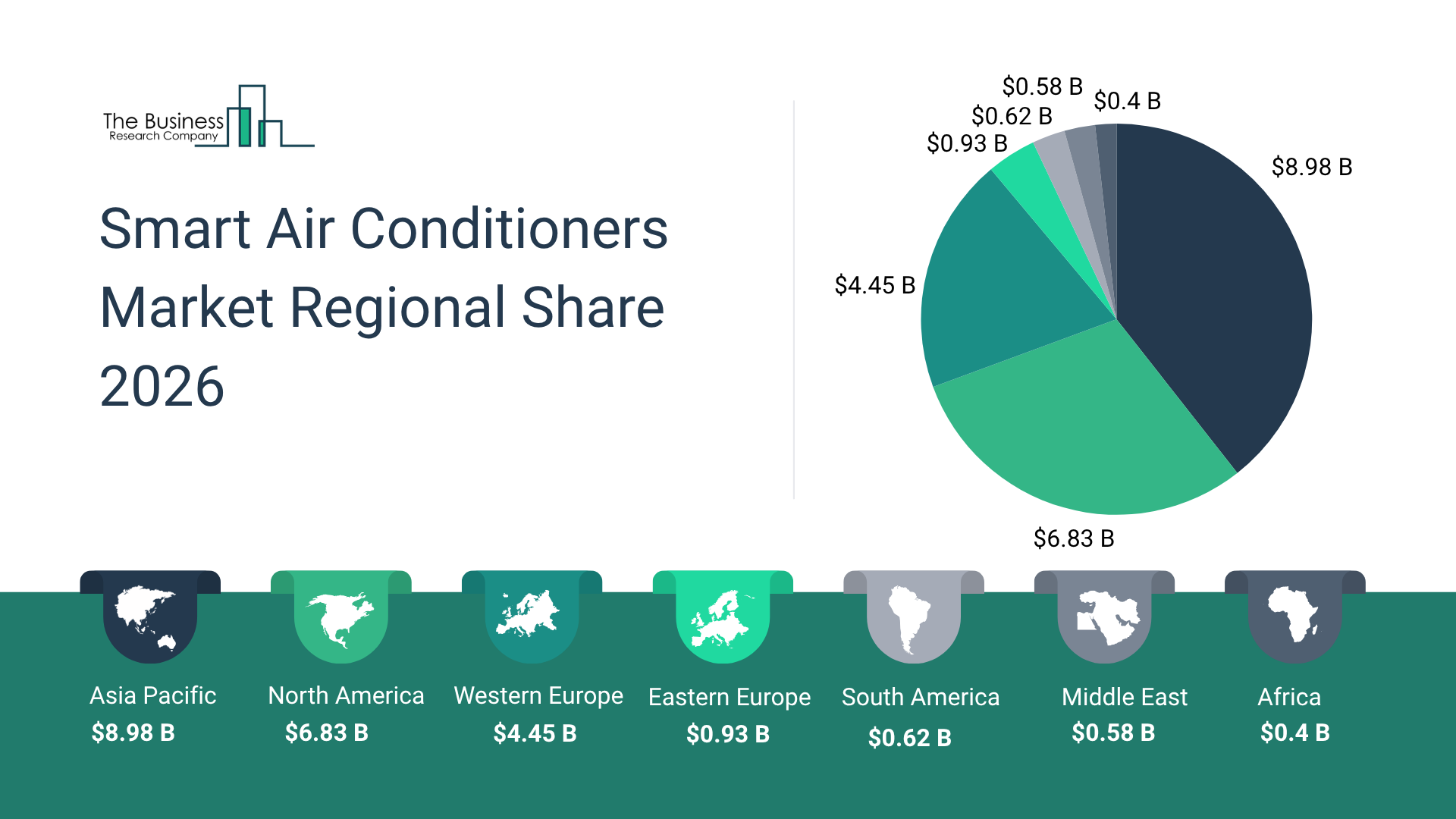
Smart Air Conditioners Market Segmentation
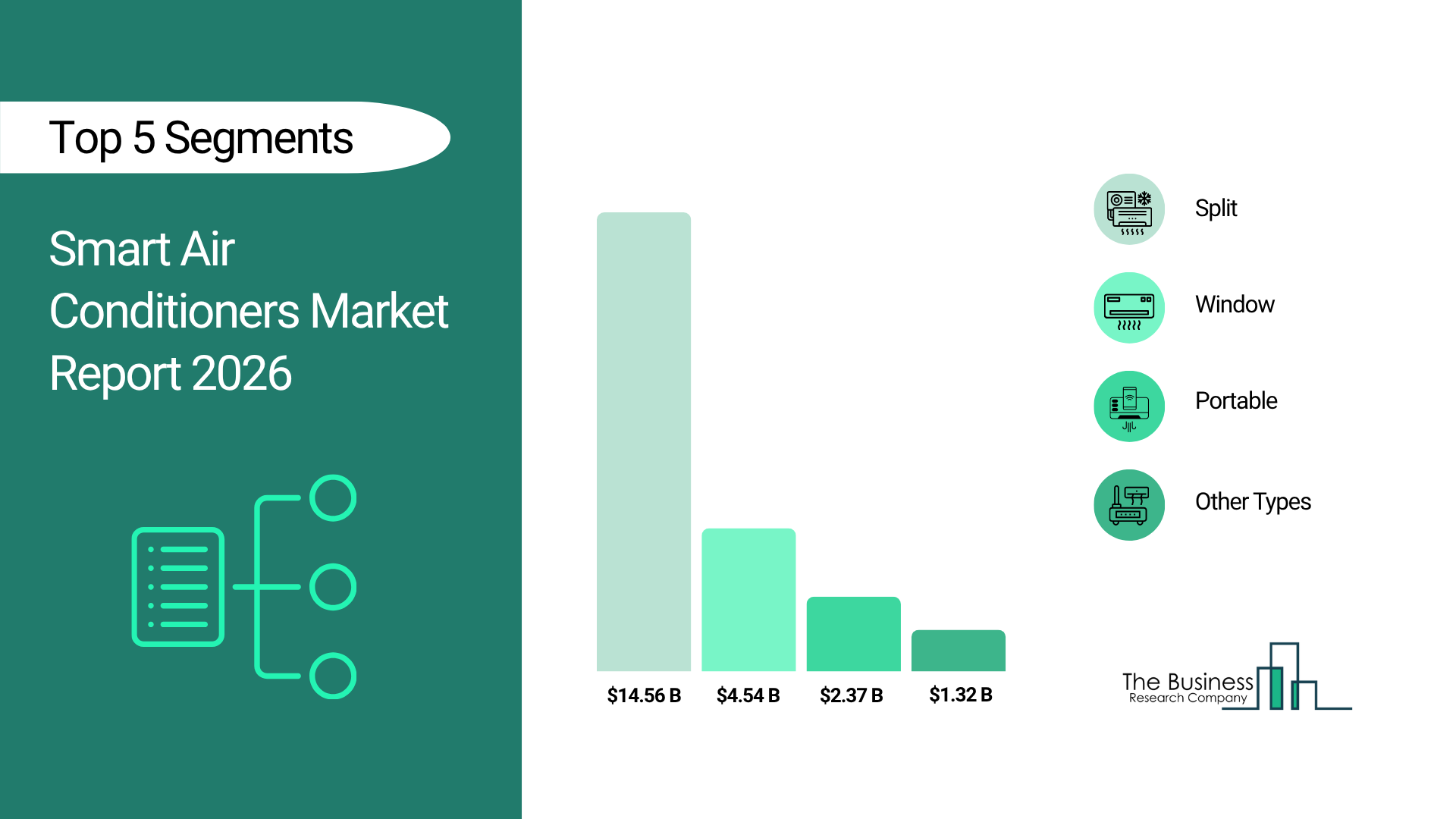
Smart Air Conditioners Market Trends and Insights
The Business Research Company's Smart Air Conditioners Market to Reach USD $34.78 Billion by 2030 at 11.1% CAGR
Expected to grow to $34.99 billion in 2030 at a compound annual growth rate (CAGR) of 11.2%”
— The Business Research Company
LONDON, GREATER LONDON, UNITED KINGDOM, May 22, 2026 /EINPresswire.com/ -- "Smart Air Conditioners market to surpass $35 billion in 2030. In comparison, the Electrical Equipment market, which is considered as its parent market, is expected to be approximately $2,330 billion by 2030, with Smart Air Conditioners to represent around 2% of the parent market. Within the broader Electrical And Electronics industry, which is expected to be $5,578 billion by 2030, the Smart Air Conditioners market is estimated to account for nearly 0.6% of the total market value.
Which Will Be The Biggest Region In The Smart Air Conditioners Market In 2030?
Asia Pacific will be the largest region in the smart air conditioners market in 2030, valued at $13 billion. The market is expected to grow from $8 billion in 2025 at a compound annual growth rate (CAGR) of 11%. The rapid growth can be attributed to the rising adoption of energy-efficient cooling systems, increasing demand for smart home appliances, rapid urbanization and residential construction activities, growing disposable incomes and changing consumer lifestyles, and expanding penetration of Internet of Things (IoT)-enabled heating, ventilation, and air conditioning (HVAC) solutions across the region.
Which Will Be The Largest Country In The Global Smart Air Conditioners Market In 2030?
The USA will be the largest country in the smart air conditioners market in 2030, valued at $9 billion. The market is expected to grow from $5 billion in 2025 at a compound annual growth rate (CAGR) of 11%. The rapid growth can be attributed to increasing adoption of smart home technologies, rising demand for energy-efficient cooling solutions, growing penetration of Internet of Things (IoT)-enabled HVAC systems, expanding residential and commercial construction activities, and strong consumer preference for automated climate control and enhanced indoor comfort across the country.
Request A Free Sample Of The Smart Air Conditioners Market Report
https://www.thebusinessresearchcompany.com/sample_request?id=14193&type=smp&utm_source=EINPresswire&utm_medium=Paid&utm_campaign=May_PR
What Will Be The Largest Segment In The Smart Air Conditioners Market In 2030?
The smart air conditioners market is segmented by type into split, window, portable, and other types. The split market will be the largest segment of the smart air conditioners market segmented by type, accounting for 64% or $22 billion of the total in 2030. The split market will be supported by their higher energy efficiency compared to conventional systems, increasing adoption in modern residential and commercial constructions, enhanced compatibility with smart thermostats and mobile applications, growing preference for aesthetically integrated and space-saving cooling solutions, and continuous advancements in inverter technology improving performance and operational efficiency.
The smart air conditioners market is segmented by connectivity into Wi-Fi, bluetooth, and other connectivities.
The smart air conditioners market is segmented by application into residential, buildings, industrial buildings, and commercial buildings.
What Is The Expected CAGR For The Smart Air Conditioners Market Leading Up To 2030?
The expected CAGR for the smart air conditioners market leading up to 2030 is 11%.
What Will Be The Growth Driving Factors In The Global Smart Air Conditioners Market In The Forecast Period?
The rapid growth of the global smart air conditioners market leading up to 2030 will be driven by the following key factors that are expected to increase the adoption of smart home ecosystems, accelerate the focus on energy efficiency and cost savings, and support the impact of rapid urbanization and rising disposable income on demand for advanced cooling solutions.
Rising Adoption Of Smart Home Ecosystems - The rising adoption of smart home ecosystems is expected to become a key growth driver for the smart air conditioners market by 2030. Consumers are increasingly integrating connected appliances within centralized home automation platforms, enabling seamless control of temperature, humidity, and air quality through smartphones and voice-enabled devices. Smart air conditioners are becoming a core component of these ecosystems due to their compatibility with digital assistants and real-time monitoring capabilities. Manufacturers are focusing on interoperability, cloud connectivity, and user-friendly interfaces to enhance consumer experience and system efficiency. This widespread integration of smart cooling solutions within connected homes is reinforcing steady market expansion. As a result, the rising adoption of smart home ecosystems is anticipated to contribute approximately 2.1% annual growth to the market.
Increasing Focus On Energy Efficiency And Cost Savings - The increasing focus on energy efficiency and cost savings is expected to emerge as a major factor driving the expansion of the smart air conditioners market by 2030. Consumers and businesses are prioritizing intelligent cooling systems that optimize energy consumption through adaptive algorithms, occupancy sensing, and automated scheduling. Smart air conditioners enable users to reduce electricity bills by adjusting cooling patterns based on real-time usage and environmental conditions. Additionally, regulatory pressures and sustainability goals are encouraging the adoption of energy-efficient appliances with advanced monitoring features. Continuous innovation in inverter technology and AI-driven optimization is further strengthening this trend. Consequently, the increasing focus on energy efficiency and cost savings is projected to contribute around 1.7% annual growth to the market.
Rapid Urbanization And Rising Disposable Income - The rapid urbanization and rising disposable income are expected to act as a key growth catalyst for the smart air conditioners market by 2030. Expanding urban populations are driving demand for modern residential and commercial infrastructure equipped with advanced climate control solutions. Higher income levels are enabling consumers to invest in premium, feature-rich air conditioning systems that offer convenience, automation, and enhanced comfort. In addition, the proliferation of smart city initiatives and digitally connected buildings is accelerating the deployment of intelligent HVAC systems. As urban lifestyles evolve, the demand for personalized and efficient cooling solutions continues to grow. Therefore, rapid urbanization and rising disposable income are projected to contribute approximately 1.6% annual growth to the market.
Access The Detailed Smart Air Conditioners Market Report Here
https://www.thebusinessresearchcompany.com/report/smart-air-conditioners-global-market-report?utm_source=EINPresswire&utm_medium=Paid&utm_campaign=May_PR
What Are The Key Growth Opportunities In The Smart Air Conditioners Market In 2030?
The most significant growth opportunities are anticipated in the split, window, portable, and other types market. Collectively, these segments are projected to contribute over $14 billion in market value by 2030, driven by increasing adoption of smart home ecosystems and IoT-enabled appliances, rising demand for energy-efficient and cost-effective cooling solutions, integration of AI-based temperature and humidity control technologies, rapid urbanization and expanding residential construction activities, growing frequency of heatwaves due to climate change, and supportive government regulations promoting energy-efficient HVAC systems and the replacement of conventional air conditioners with smart, connected alternatives. This surge reflects the accelerating shift toward intelligent climate control systems, enhanced consumer preference for automation and remote accessibility, and a strong global focus on sustainability and reduced energy consumption across the smart air conditioners industry.
The split market is projected to grow by $9 billion, the window market by $3 billion, the portable market by $1 billion, and the other types market by $1 billion over the next five years from 2025 to 2030.
Learn More About The Business Research Company
The Business Research Company (www.thebusinessresearchcompany.com) is a leading market intelligence firm renowned for its expertise in company, market, and consumer research. We have published over 17,500 reports across 27 industries and 60+ geographies. Our research is powered by 1,500,000 datasets, extensive secondary research, and exclusive insights from interviews with industry leaders.
We provide continuous and custom research services, offering a range of specialized packages tailored to your needs, including Market Entry Research Package, Competitor Tracking Package, Supplier & Distributor Package and much more.
Disclaimer: Please note that the findings, conclusions and recommendations that TBRC Business Research Pvt Ltd delivers are based on information gathered in good faith from both primary and secondary sources, whose accuracy we are not always in a position to guarantee. As such TBRC Business Research Pvt Ltd can accept no liability whatever for actions taken based on any information that may subsequently prove to be incorrect. Analysis and findings included in TBRC reports and presentations are our estimates, opinions and are not intended as statements of fact or investment guidance.
Contact Us:
The Business Research Company
Americas +1 310-496-7795
Europe +44 7882 955267
Asia & Others +44 7882 955267 & +91 8897263534
Email: marketing@tbrc.info
Follow Us On:
LinkedIn: https://in.linkedin.com/company/the-business-research-company"
Oliver Guirdham
The Business Research Company
+44 7882 955267
info@tbrc.info
Visit us on social media:
LinkedIn
Facebook
X
Legal Disclaimer:
EIN Presswire provides this news content "as is" without warranty of any kind. We do not accept any responsibility or liability for the accuracy, content, images, videos, licenses, completeness, legality, or reliability of the information contained in this article. If you have any complaints or copyright issues related to this article, kindly contact the author above.
