

The latest news on business and economy
Provided by AGP
Economic Bulletin Issue 3, 2026
Summary
At its meeting on 30 April 2026, the Governing Council decided to keep the three key ECB interest rates unchanged. While the incoming information has been broadly consistent with its previous assessment of the inflation outlook, the upside risks to inflation and the downside risks to growth have intensified. The Governing Council is committed to setting monetary policy to ensure that inflation stabilises at the 2% target in the medium term.
The war in the Middle East has led to a sharp increase in energy prices, pushing up inflation and weighing on economic sentiment. The implications of the war for medium-term inflation and economic activity will depend on the intensity and duration of the energy price shock and the scale of its indirect and second-round effects. The longer the war continues and the longer energy prices remain high, the stronger is the likely impact on broader inflation and the economy.
The Governing Council remains well positioned to navigate the current uncertainty. The euro area entered this period of surging energy prices with inflation at around the 2% target, and the economy has shown resilience over recent quarters. Longer-term inflation expectations remain well anchored, although inflation expectations over shorter horizons have moved up significantly.
The Governing Council will closely monitor the situation and follow a data-dependent and meeting-by-meeting approach to determining the appropriate monetary policy stance. In particular, its interest rate decisions will be based on its assessment of the inflation outlook and the risks surrounding it, in light of the incoming economic and financial data, as well as the dynamics of underlying inflation and the strength of monetary policy transmission. The Governing Council is not pre-committing to a particular rate path.
Economic activity
The euro area economy was showing some momentum when the current turbulence started. Real GDP grew by 0.1% in the first quarter of 2026, according to Eurostat’s preliminary flash estimate. Domestic demand remains the main driver of growth, supported by a resilient labour market. However, the economic outlook is highly uncertain and will depend on how long the war in the Middle East lasts and how strongly it affects energy and other commodity markets, as well as global supply chains.
The incoming information suggests that the conflict is weighing on economic activity. Survey results point to slowing growth, and consumers and businesses have become less confident about the future since the war began. Longer delivery times and rising input prices suggest supply chains are coming under pressure.
Looking ahead, high energy costs are expected to continue to weigh on real incomes, making households and firms more reluctant to consume and invest. While unemployment remained close to historical lows in March 2026, at 6.2%, labour demand has cooled further. At the same time, households are still benefiting from a solid financial position, and investment should continue to be underpinned by governments spending more on defence and infrastructure and by firms increasingly investing in new digital technologies. This favourable starting point provides some cushioning against the fallout from the war.
The Governing Council highlighted the urgent need to strengthen the euro area economy while maintaining sound public finances. Fiscal responses to the energy price shock should be temporary, targeted and tailored. Reforms to enhance the euro area’s growth potential and accelerate the energy transition to reduce reliance on fossil fuels are more vital than ever. Completing the savings and investments union is key to funding innovation, supporting the green and digital transitions and improving productivity. The digital euro and tokenised wholesale central bank money will enhance Europe’s strategic autonomy, competitiveness and financial integration, and will boost innovation in payments. It is thus essential to swiftly adopt the Regulation on the establishment of the digital euro. Simplifying and harmonising rules across the EU’s Single Market will help European firms grow faster.
Inflation
In April 2026 inflation rose to 3.0%, from 2.6% in March and 1.9% in February. The rise has been driven by surging energy prices caused by the war in the Middle East. Energy price inflation jumped to 10.9%, after 5.1% in March, and food price inflation edged up to 2.5%. Inflation excluding energy and food decreased to 2.2%, from 2.3% in March, reflecting a fall in services inflation, which declined to 3.0%, from 3.2% in March. Goods inflation went up to 0.8%, from 0.5% in March.
Indicators of underlying inflation have changed little over recent months. For now, the ECB’s wage tracker and the results of surveys on wage expectations continue to indicate easing labour costs in the course of 2026. At the same time, survey results indicate an increase in other cost components and in selling price expectations. Inflation expectations have moved up significantly over shorter horizons. Most measures of longer-term inflation expectations stand at around 2%, supporting the stabilisation of inflation around target in the medium term.
The increase in energy prices will keep inflation well above 2% in the near term. As the period of high energy prices extends, the likely impact on broader inflation through indirect and second-round effects intensifies. The Governing Council will therefore closely monitor the size and persistence of the energy price surge, and how it feeds through to price and wage-setting, inflation expectations and overall economic dynamics.
Risk assessment
The risks to the growth outlook are to the downside. The war in the Middle East remains a downside risk to the euro area economy, adding to the volatile global policy environment. Prolonged disruption of the supply of energy could increase energy prices further and for longer than currently expected. These factors would erode incomes and make firms and households more reluctant to invest and spend. The drag on growth would intensify if the closure of major shipping routes were to cause acute shortages of key inputs that forced euro area firms to curtail output. A worsening of global financial market sentiment could further dampen demand. Additional frictions in international trade could exacerbate supply chain disruptions, reduce exports and weaken consumption and investment. Other geopolitical tensions, in particular Russia’s unjustified war against Ukraine, remain a major source of uncertainty. By contrast, growth could turn out to be higher if the economy proved to be more adaptable to the disruption caused by the war in the Middle East or if the conflict were resolved more quickly than currently expected. Moreover, planned defence and infrastructure spending, reforms to enhance productivity, and euro area firms adopting new technologies may drive up growth by more than expected. New trade agreements and a deeper integration of the Single Market could also boost growth beyond current expectations.
The risks to the inflation outlook are to the upside. If energy prices were to rise by more and for longer than currently expected, euro area inflation would increase further. This could be reinforced and become more persistent if higher energy prices were to spill over by more than expected to other prices and to wages, if longer-term inflation expectations were to rise in response or if global supply chains were disrupted more broadly. Ongoing trade tensions could also give rise to more fragmented global supply chains, curtail the supply of critical raw materials and worsen capacity constraints in the euro area economy. By contrast, inflation could turn out to be lower if the economic effects of the war in the Middle East proved to be more short-lived than currently expected or if indirect and second-round effects proved less pronounced. More volatile and risk-averse financial markets could weigh on demand and thereby lower inflation as well.
Financial and monetary conditions
The war in the Middle East has caused significant volatility in global financial markets. Overall financial conditions remain tighter than before the war.
The cost of issuing market-based debt rose to 3.9% in March 2026, from 3.5% in February. Bank lending rates for firms – based on data recorded prior to the war – edged down to 3.5% in February, while mortgage rates remained at 3.4%.
The annual growth rate of bank lending to firms increased to 3.2% in March, from 3.0% in February, while the growth rate of corporate bond issuance fell to 3.9%, from 4.5% in February. Credit standards for loans to firms tightened in the first quarter, as reported in the April 2026 bank lending survey for the euro area. This tightening was due to banks becoming more concerned about the economic risks faced by their customers. Demand for loans to firms decreased slightly in the first quarter, especially for fixed investment.
Mortgage lending grew by 3.0% in March, after 3.1% in February, amid a small tightening in credit standards and unchanged demand.
Monetary policy decisions
The interest rates on the deposit facility, the main refinancing operations and the marginal lending facility were kept unchanged at 2.00%, 2.15% and 2.40% respectively.
The asset purchase programme and pandemic emergency purchase programme portfolios are declining at a measured and predictable pace, as the Eurosystem no longer reinvests the principal payments from maturing securities.
Conclusion
At its meeting on 30 April 2026, the Governing Council decided to keep the three key ECB interest rates unchanged. It is committed to setting monetary policy to ensure that inflation stabilises at its 2% target in the medium term. It will follow a data-dependent and meeting-by-meeting approach to determining the appropriate monetary policy stance. The Governing Council’s interest rate decisions will be based on its assessment of the inflation outlook and the risks surrounding it, in light of the incoming economic and financial data, as well as the dynamics of underlying inflation and the strength of monetary policy transmission. The Governing Council is not pre-committing to a particular rate path.
In any case, the Governing Council stands ready to adjust all of its instruments within its mandate to ensure that inflation stabilises sustainably at its medium-term target and to preserve the smooth functioning of monetary policy transmission.
1 External environment
Global economic activity has remained relatively resilient but is beginning to weaken, as the war in the Middle East weighs on energy markets, confidence and short-term growth prospects. Higher oil and gas prices, driven by reduced supply from the Gulf, are affecting energy-importing economies, notably Japan, South Korea and India. Global inflation stabilised by February 2026, but rising energy prices are generating renewed upward pressure. The direct impact on global trade, aside from the energy sector, has been limited so far. Disruptions to non-energy shipping have remained limited, despite tensions affecting energy transit through the Strait of Hormuz. However, indirect effects may still emerge, because even though non-energy exports from the Gulf are limited, disruptions to key inputs such as helium and methanol could affect sectors such as microchips and aerospace.
Global economic activity has remained resilient but is showing early signs of weakening. With the war in the Middle East weighing on energy markets, confidence and near-term growth prospects, the global composite output Purchasing Managers’ Index (PMI), excluding the euro area, declined to 50.9 in March 2026 from 53.5 in February, but remained in expansionary territory (Chart 1). According to this survey indicator, economic activity in March slowed more sharply in emerging Asia, including China, and in the United States. Rising energy prices also appear to be dampening consumer spending, with PMI indicators for consumer-oriented sectors showing the greatest weakening. At the same time, consumer confidence surveys point to a modest decline in household sentiment, albeit far less severe than during the 2022 energy shock. As the energy shock continues to feed through the economy, its drag on economic activity is expected to intensify over the coming quarters.
Chart 1
Global output PMI (excluding the euro area)
(diffusion indices)
Sources: S&P Global Market Intelligence and ECB staff calculations.
Notes: The horizontal line at 50 marks the neutral baseline dividing expansion and contraction. The latest observations are for March 2026.
Energy prices remain highly volatile following disruptions to shipping through the Strait of Hormuz. Brent crude oil prices have risen by 9%, reaching USD 120 per barrel, as the continued blockade of the Strait has amplified the size of the oil supply shock. Prices remained highly volatile as market sentiment fluctuated between optimism around the potential reopening of the Strait of Hormuz – particularly following the ceasefire announcement agreed between the United States and Iran in early April – and pessimism whenever tensions rose, including due to attacks on oil tankers. Overall, oil prices stand 67% above pre-conflict levels. By contrast, gas prices declined by 14% after the ceasefire announcement but remain 47% higher than before the conflict. Much of this increase, in Europe’s case, is largely driven by precautionary demand linked to concerns about future supply disruptions, rather than an actual reduction in import volumes. This is demonstrated by a marked slowdown in inventory depletion, indicating that shortfalls have been avoided to date. This relative resilience reflects, first, the delayed impact of disruptions to Qatari liquefied natural gas (LNG) shipments on European imports and, second, the overall limited exposure of Europe to Middle Eastern LNG exports. It has also been supported by weaker demand for LNG from China owing to milder weather. Despite rising fertiliser prices, food prices have remained rather stable so far, particularly when set against the pressures seen in 2022. Unlike the current shock, the crisis in 2022 combined an energy shock with a significant food supply shock – as Ukraine and Russia were major cereal exporters – which is not the case today. In addition, cereal inventories remain high, providing a buffer against supply fluctuations for potential yield declines. Fertilisers are also heavily subsidised in many countries, which makes their final use less sensitive to price changes. Meanwhile, metal prices have increased by 7%, with supply disruptions in the Middle East pushing up the price of aluminium.
The war in the Middle East is weighing on energy-importing economies, whereas its broader impact on global trade has been limited to date. Reduced energy exports from the Gulf are affecting energy-intensive industries, with Japan, South Korea and India being most exposed. Although reserves provide short-term buffers, early signs of strain are emerging, including longer delivery times and upward pressure on prices. By contrast, disruptions to non-energy trade have been contained. Traffic through the Strait of Hormuz accounts for only a small share of global shipping capacity and trade through the Suez Canal had already been rerouted in response to earlier risks. As a result, freight costs for non-energy goods have remained broadly stable. PMI export orders point to robust trade momentum at the start of 2026, albeit their decline in March signals a possible slowdown. Inventory indicators do not show evidence of stockpiling and short-term estimates imply that global trade growth could ease from around 1.2% quarter on quarter in early 2026 to around 0.6% in the second quarter. While the war could still affect supply chains through non-energy Gulf exports, exposure remains limited. These exports account for less than 1% of imports in most economies and roughly 1% of global trade, suggesting a smaller impact than previous disruptions in East Asia. Risks are concentrated in specific products such as helium and methanol, of which Gulf countries hold large market shares, with potential knock-on effects for specific sectors such as microchips and aerospace.
Headline inflation stabilised at 2.2% in February 2026, before the war in the Middle East escalated and the subsequent rise in energy prices began to generate renewed upward pressure. Core inflation edged up to 2.6% from 2.5% in January, still well below the peaks seen in 2022 (Chart 2). However, rising energy prices are beginning to spread across the global economy. In March, both the United States and China reported increases in energy-related inflation, with global PMI input and output prices rising sharply to their highest levels since 2022, signalling a renewed build-up of pipeline pressures.
Chart 2
OECD CPI inflation
(year-on-year percentage changes, percentage point contributions)
Sources: OECD and ECB staff calculations.
Notes: The OECD aggregate includes euro area countries that are OECD member countries and excludes Türkiye. It is calculated using OECD consumer price index (CPI) annual weights. The latest observations are for February 2026.
Inflationary pressures stemming from the current energy shock could be more contained than those observed in the 2022 crisis. Global demand is more subdued than in the period following the COVID-19 pandemic and monetary policy across advanced economies is now broadly neutral to restrictive. Labour market tightness has also eased, as reflected in a lower vacancy-to-unemployment ratio and in the moderating nominal wage growth, thus reducing the risk of pronounced wage-price dynamics. These factors combined suggest that rising energy prices will have less of an impact on core inflation. At the same time, inflation expectations may be more sensitive to renewed energy shocks, given the relatively recent period of elevated inflation in many economies, and firms may be faster to adjust prices.
In the United States, economic activity weakened at the start of 2026 and inflationary pressures intensified. Private consumption growth slowed markedly between December 2025 and February 2026, driven by falling goods spending. Services consumption, though moderating, remained relatively resilient. This pattern is consistent with weaker growth in disposable income, reflecting softer employment and wage dynamics, alongside very low consumer confidence. Real GDP growth in the fourth quarter of 2025 was revised downwards significantly, from an initial estimate of 0.4% quarter on quarter to 0.1%. This marks a sharp deceleration from the third quarter of 2025, mainly on account of reduced government spending amid government shutdowns. Growth was set to rebound in the first quarter of 2026 as government activity normalised. However, data for March are still scarce and do not yet fully capture the effects of the war. Labour market data present a mixed picture. Non-farm payrolls rose strongly by 178,000 in March, supported by healthcare hiring, whereas public employment continued to decline. The unemployment rate edged downwards to 4.3% on account of lower labour force participation. Wage growth moderated slightly and hiring rates fell to their lowest level since April 2020. Inflation rose sharply, with headline consumer price index (CPI) inflation reaching 3.3% year on year in March, driven largely by energy prices. Core inflation increased modestly to 2.6%, but underlying pressures persist, including tariff pass-through. Inflation is expected to rise further, with risks skewed upwards, reducing expectations of near-term monetary policy easing.
Growth in China strengthened at the start of 2026, supported by a rebound in investment and strong domestic spending. Quarterly GDP growth edged upwards, from 1.2% in the fourth quarter of 2025 to 1.3% in the first quarter of 2026, somewhat higher than market expectations. Industrial activity picked up, reflecting a gradual recovery in fixed investment following earlier declines. While services activity remains below historical levels, both retail sales and services output have improved, bolstered by Chinese New Year spending. Exports remained buoyant in the first quarter of 2026 but contributed only modestly to overall growth, as imports also increased. Domestic demand continues to underperform and the property sector remains a persistent drag. Inflation dynamics are mixed: CPI inflation moderated in March 2026, as energy price caps have limited the pass-through of higher energy prices, and producer prices turned positive for the first time since 2022, driven by energy costs. The exposure of China to energy shocks is relatively limited compared with other Asian economies. Its energy mix is less reliant on oil and gas, reflecting the continued role of coal and the rapid expansion of renewable energy. Diversified supply sources and sizeable oil inventories provide additional buffers, despite some reliance on the Strait of Hormuz. At the same time, China faces headwinds from weaker regional demand. Across Asian economies, rising commodity prices are likely to lift inflation and dampen growth, further depressing external demand. Higher energy costs are also weighing on the current accounts of net energy-importing economies, as trade balances deteriorate. This, in turn, may exert downward pressure on exchange rates.
In the United Kingdom, real GDP growth is expected to have remained modest in the first quarter of 2026. Following weak growth of 0.1% in the fourth quarter of 2025, high-frequency indicators point towards only a modest pick-up. PMI data improved in January and February 2026 before falling sharply in March and consumer sentiment weakened significantly, likely reflecting the effects of the war in the Middle East. Headline inflation increased to 3.3% in March 2026, whereas core inflation decreased slightly, from 3.2% to 3.1%. Against a backdrop of rising inflationary pressures, the Bank of England kept its policy rate unchanged at 3.75% at the March meeting of its Monetary Policy Committee.
2 Economic activity
After expanding steadily in 2025, real GDP continued to grow modestly in the first quarter of 2026. Domestic demand remained the main driver of growth, supported by a resilient labour market. Nevertheless, momentum has weakened following the outbreak of the war in the Middle East, leading to a marked deterioration in confidence from March onwards, particularly among consumers and retailers. The incoming survey data thus suggest that the conflict is beginning to weigh on economic activity. While contacts in the corporate sector reported that current conditions are broadly manageable, the April euro area flash composite output Purchasing Managers’ Index (PMI) fell into contractionary territory, driven by services, and the PMI for business expectations worsened markedly. Signs of renewed supply chain pressures have emerged, as reflected in longer delivery times and higher input prices. The economic outlook is highly uncertain and will depend on how long the war in the Middle East lasts and how strongly it affects energy and other commodity markets, as well as global supply chains. Looking ahead, high energy costs are expected to continue to weigh on real incomes, making households and firms more reluctant to consume and invest. While unemployment remained close to historical lows in March, labour demand has cooled further. At the same time, resilient household balance sheets and declining energy dependence may partly mitigate the impact. Business investment is expected to remain broadly supportive of growth, with higher government spending on defence and infrastructure, and firms increasingly investing in new digital technologies. This favourable starting point provides some cushioning against the fallout from the war.
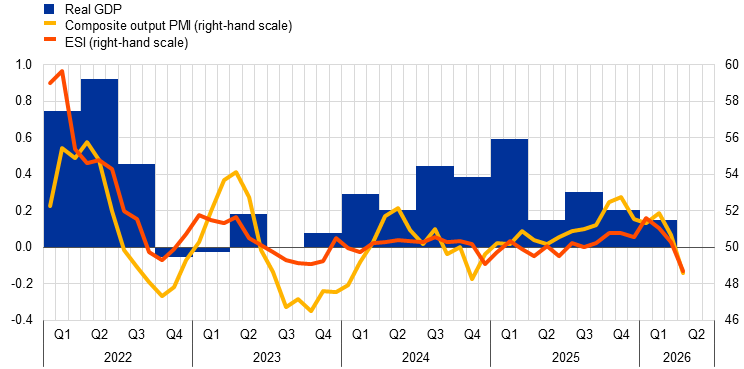
Euro area GDP growth slowed in the first quarter of 2026. According to Eurostat’s preliminary flash estimate, real GDP edged up by 0.1% in the first quarter (Chart 3), after having expanded by 0.2% in the fourth quarter of 2025.[1] Among the largest euro area countries, GDP increased by 0.6% quarter on quarter in Spain, by 0.3% in Germany, by 0.2% in Italy and by 0.1% in the Netherlands, while it remained unchanged in France. Dispersion of real GDP growth across euro area Member States (excluding Ireland) has declined over recent quarters and is relatively low by historical standards, indicating limited divergence in growth dynamics across countries. Differences in growth performance appear to be more closely related to demographic and labour market trends than to differences in productivity growth (see Box 3). Although the expenditure breakdown is not yet available, conjunctural indicators and country-level data suggest that the contribution of domestic demand to growth moderated in the first quarter of 2026. Production data point to slowing dynamics in services and weak manufacturing. Over January and February industrial production (excluding construction) stood, on average, 1.0% lower than in the fourth quarter of 2025, and retail sales were flat, while services production increased marginally in January compared with December.
Chart 3
Euro area real GDP, composite output PMI and ESI
(left-hand scale: quarter-on-quarter percentage changes; right-hand scale: diffusion index)
Sources: Eurostat, European Commission and S&P Global.
Notes: The two lines indicate monthly developments; the bars show quarterly data. For the composite output PMI, the horizontal line at 50 marks the neutral baseline dividing expansion and contraction. The European Commission’s Economic Sentiment Indicator (ESI) has been standardised and rescaled to have the same mean and standard deviation as the composite output PMI. The latest observations are for the first quarter of 2026 for real GDP and for April 2026 for the composite output PMI and the ESI.
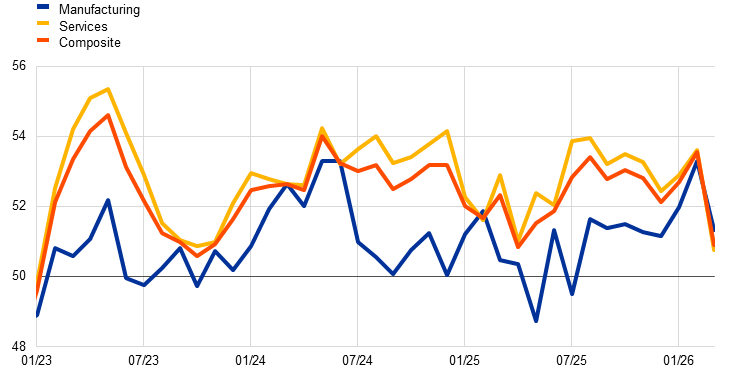
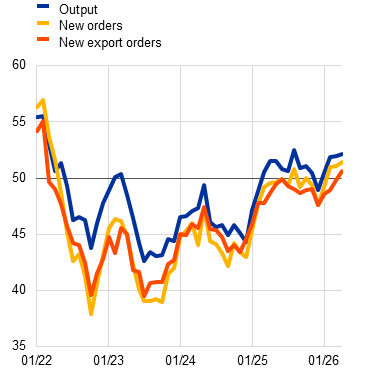
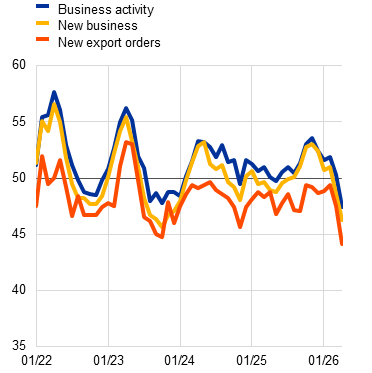
Confidence fell markedly following the outbreak of the war in the Middle East, and survey indicators point to weakening growth momentum in the second quarter of 2026 and beyond. The euro area composite output PMI decreased in both March and April, falling below the threshold of 50. This deterioration was entirely driven by services activity, which has been the sole driver of growth over recent quarters (Chart 4). Manufacturing sector activity remained in positive territory, which may partly reflect spending on defence and frontloading of purchases in anticipation of future oil price increases or supply shortages. The European Commission’s Economic Sentiment Indicator also fell significantly in both March and April, with a particularly sharp decline among consumers, and in the services and retail sectors. At the same time, supply chain disruptions have clearly intensified. The PMI for suppliers’ delivery times worsened sharply in March and April, mirroring the severity of the deterioration observed in April 2022. PMI manufacturing input prices – a complementary indicator of supply bottlenecks – also increased strongly. Information from corporate sector contacts suggests that a prolongation of the conflict into May-June could trigger broader supply chain disruptions, in particular owing to potential shortages of oil and oil-based products that are critical for manufacturing processes. However, contacts generally expect any such disruptions to be less severe than those experienced during the pandemic (see Box 6).
Chart 4
PMI indicators across sectors of the economy
a) Manufacturing |
b) Services |
|---|---|
(diffusion indices) |
(diffusion indices) |
 |
 |
Source: S&P Global Market Intelligence.
Note: The latest observations are for April 2026.
Forward-looking indicators have also deteriorated notably since the outbreak of the war. The composite PMI for new business declined strongly in March and April, driven entirely by the services sector. The PMI for business expectations one year ahead also dropped significantly, standing well below its historical average in April, with indicators for both manufacturing and services sectors showing marked declines. Overall, these developments point to a growing sense of pessimism, as firms increasingly expect the conflict to weigh more visibly on activity in the coming months.
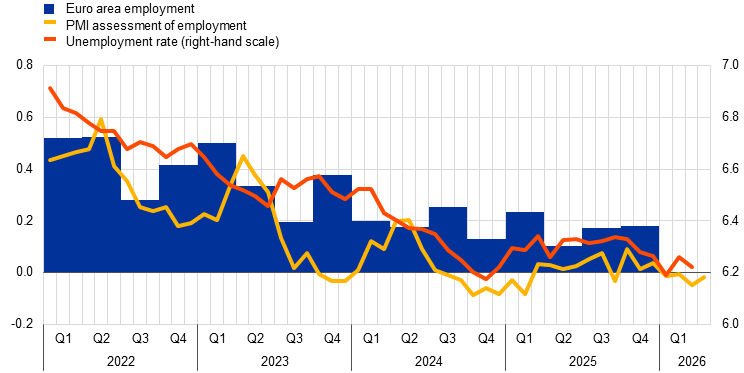
Labour market conditions remain stable overall, although labour demand is gradually cooling. Employment and total hours worked increased by 0.2% and 0.6% respectively in the fourth quarter of 2025 (Chart 5). The ongoing moderation in employment growth partly reflects a continued softening in labour demand. The job vacancy rate stabilised at 2.2% in the fourth quarter, thereby remaining below the pre-pandemic levels observed in the fourth quarter of 2019 for the second consecutive quarter. The tendency for older workers to retire later than in previous generations has supported the employment rate among the euro area population in recent years (see Box 5). The labour force expanded further, by 0.9% year on year, in the fourth quarter of 2025, while the latest monthly numbers indicate a moderation in growth. At the same time, the unemployment rate stood at 6.2% in March, down from 6.3% in February, but remaining close to historically low levels.
Chart 5
Euro area employment, PMI assessment of employment and unemployment rate
(left-hand scale: quarter-on-quarter percentage changes, diffusion index; right-hand scale: percentages of the labour force)
Sources: Eurostat, S&P Global Market Intelligence and ECB calculations.
Notes: The two lines indicate monthly developments, while the bars show quarterly data. The PMI is expressed in terms of the deviation from 50, then divided by 10 to gauge quarter-on-quarter employment growth. The unemployment rate series now includes Bulgaria and this change induced a downward level shift in the euro area aggregate of around 0.1 percentage points. The latest observations are for the fourth quarter of 2025 for euro area employment, April 2026 for the PMI assessment of employment and March 2026 for the unemployment rate.
Short-term labour market indicators suggest muted employment growth in the first quarter of 2026. According to the PMI flash release, the monthly composite PMI employment indicator stood at 49.8 in April, slightly above the value of 49.5 recorded in March, suggesting broadly flat employment developments. The indicator dropped further into contractionary territory in the manufacturing sector while it increased in the services sector, remaining just above the threshold of 50.
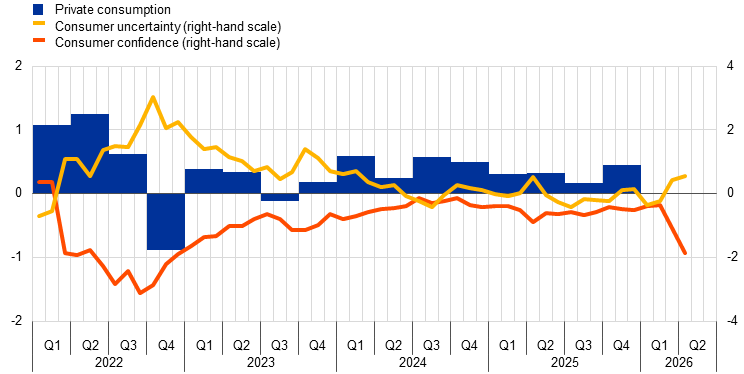
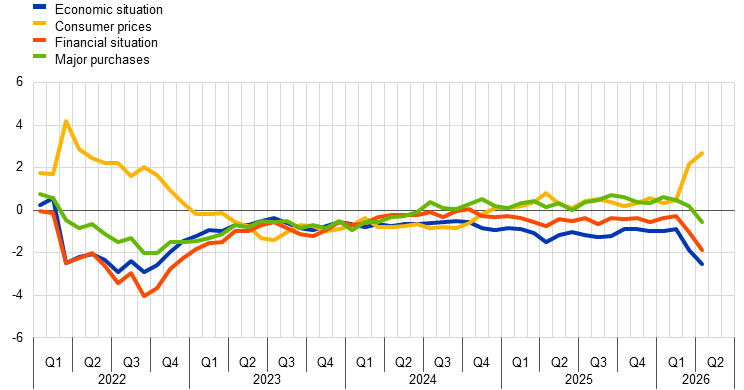
Private consumption likely slowed in the first quarter of 2026, while the short-term outlook is subject to headwinds stemming from the war in the Middle East. Following the strong momentum seen at the end of 2025, household spending appears to have moderated in early 2026 – with some softening possibly already underway before the onset of the conflict. Consistent with this, retail trade volumes remained broadly flat in the first quarter of 2026 (January-February average) compared with the fourth quarter of 2025. Survey evidence also points to a softening in consumption dynamics amid heightened geopolitical uncertainty. The European Commission consumer confidence indicator declined in March, mainly driven by weaker expectations for the general economic situation amid geopolitical tensions in the Middle East (Chart 6, panel a), and fell further in April to its lowest level since the end of 2022. Meanwhile, consumer uncertainty increased, suggesting more cautious spending behaviour by households. However, the deterioration in households’ expectations remains significantly less pronounced than the decline seen in the aftermath of Russia’s invasion of Ukraine (Chart 6, panel b). The European Commission consumption-weighted expected activity indicator – an aggregate index based on business expectations for activity over the next three months – dropped further in March, moving closer to its long-term average. In addition, the ECB Consumer Expectations Survey indicates that expectations for holiday-related purchases weakened further in March. Looking ahead, the outlook for private consumption is facing headwinds, although some mitigating factors remain in place. Higher energy prices may weigh on real income growth and restrain household spending. At the same time, households could draw on their savings to cushion the impact of the energy shock, while elevated uncertainty could encourage them to maintain or rebuild precautionary savings buffers, thereby weighing on private consumption (see Box 4).
Chart 6
Household consumption and households’ expectations
a) Real private consumption, consumer confidence and uncertainty
(quarter-on-quarter percentage changes, standardised percentage balances)
b) Households’ expectations
(standardised percentage balances)
Sources: Eurostat, European Commission and ECB calculations.
Notes: “Consumer uncertainty” refers to the European Commission consumer economic uncertainty index. All series from the European Commission Business and Consumer Survey are standardised for the whole sample from January 1999, except for consumer uncertainty, which is standardised for the whole sample from April 2019, owing to data availability. The latest observations are for the fourth quarter of 2025 for private consumption and April 2026 for all other variables.
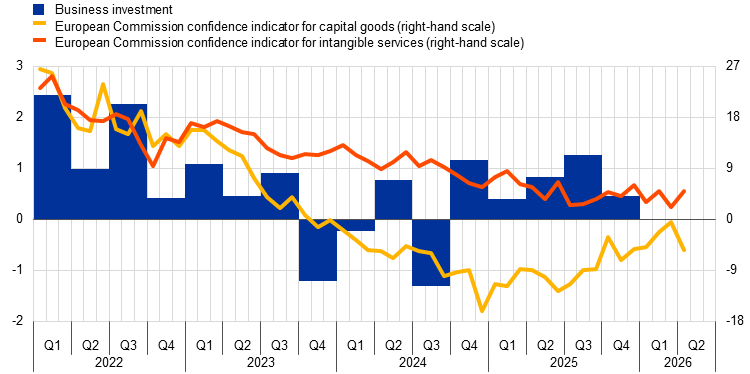
Business investment has likely continued to grow in the first quarter of 2026, but a prolonged war in the Middle East could give rise to downside risks in the second half of the year. Drivers of investment remained sound before the war in the Middle East, with improving corporate profits, healthy balance sheets and strong demand for digital technologies. In the first quarter of 2026, despite the outbreak of the conflict, the European Commission confidence indicator for the capital goods sector improved through to March. Confidence in the intangible services sectors remained positive – albeit weakening slightly – during the period (Chart 7, panel a). Overall, this suggests positive investment growth at the start of 2026. The picture changed with the outbreak of the war in the Middle East. Uncertainty and oil prices rose and the European Commission confidence indicator for the capital goods sector dropped in April. Business investment growth is expected to be muted for the remainder of 2026, with downside risks in the second half of the year should the war in the Middle East persist and uncertainty remain high (see Box 6). Industrial firms could face more severe global supply chain disruptions, with higher energy prices feeding through to aluminium, steel and other components. Digital investment could be adversely affected through critical supply chains, particularly by disruptions affecting semiconductor supply and data centre construction. Looking ahead, demand for digitalisation and defence spending, along with remaining Next Generation EU funds, should mitigate the adverse impact of these factors on business investment.
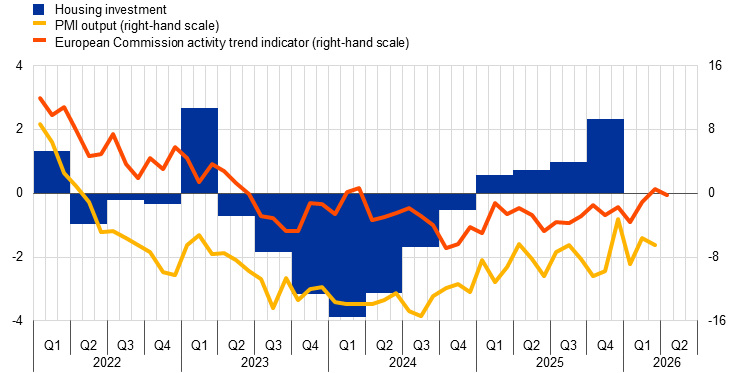
Chart 7
Real investment dynamics and survey data
a) Business investment
(quarter-on-quarter percentage changes and percentage balances)
b) Housing investment
(quarter-on-quarter percentage changes; percentage balances and diffusion index)
Sources: Eurostat, European Commission, S&P Global Market Intelligence and ECB calculations.
Notes: The lines indicate monthly developments, while the bars refer to quarterly data. In panel a), business investment is measured by non-construction investment excluding Irish intangibles. The European Commission confidence indicator for intangible services refers to a weighted average of publishing activities (J58); computer programming, consultancy and related activities (J62); and information service activities (J63). In panel b), the PMI is expressed in terms of the deviation from 50. The line for the European Commission activity trend indicator refers to the weighted average of the building and specialised construction sectors’ assessment of the trend in activity over the preceding three months, rescaled to have the same standard deviation as the PMI. The line for PMI output refers to housing activity. The latest observations are for the fourth quarter of 2025 for investment, March 2026 for PMI output and April 2026 for the European Commission indicators.
Housing investment appears to have continued to recover in the first quarter of 2026, supported by finishing works. The overall positive trend in housing investment (Chart 7, panel b) continued to be driven by finishing works (specialised construction activities), which also include renovation work on existing buildings. These works continued to outperform the construction of new buildings, both at the euro area level and across the largest euro area countries. Short-term indicators fell recently but the trend remains broadly supportive. The European Commission indicator for recent trends in building and specialised construction activity declined in April but remained close to its highest level since the first quarter of 2024, while the PMI housing output index declined slightly but remained above its January value. Looking ahead, consumer assessment of housing as a good investment remains at high levels according to the ECB Consumer Expectations Survey, pointing to robust underlying demand. At the same time, households’ mortgage rate expectations increased in March, suggesting downside risks to the ongoing recovery in housing demand. These risks reflect the prospects of less favourable financing conditions following the energy-driven price shock and the deterioration in confidence associated with the conflict.
Euro area exports continue to encounter headwinds from US tariffs and competition from China. Goods export volumes declined by 3.4% in three-month-on-three-month terms in February 2026, having also contracted in January. Exports to both the United States and the rest of the world decreased, underscoring the ongoing challenges for euro area exporters. Survey indicators suggest that new export orders continued to decline in March as well. Looking ahead, competitiveness challenges for European exporters are likely to intensify amid persistent disruptions in energy and commodity markets, given that oil and gas remain central to the euro area’s energy mix, making it particularly exposed to global price shocks. Overall, euro area exporters are facing a triple challenge: US tariffs, competition from China and rising energy prices. Concerns are rising about potential jet fuel shortages, which could trigger air traffic disruptions and rising flight fares, thereby dampening tourism demand. At the same time, the adverse effect on demand could be partly offset by some diversion of tourism flows towards European destinations. However, while there are no discernible effects on high-frequency flight passenger data so far, survey indicators are pointing to weakening demand for tourism services amid heightened uncertainty. Import volumes decreased by 1.5% in three-month-on-three-month terms in February, driven largely by a significant drop in imports of chemicals (including pharmaceuticals) from the United States, while imports from China continued to grow. Meanwhile, import prices continued their downward trend, falling by 3.5% year on year in January. This decline still reflects the impact of the appreciation of the euro since the spring of 2025, along with sustained downward price pressures from China.
Overall, the economic outlook remains highly uncertain, hinging on the duration of the war and its impact on energy, other commodity markets and global supply chains. At the same time, solid household balance sheets, together with increased spending on defence and infrastructure, as well as continued investment in digital technologies, should help cushion the impact.
3 Prices and costs
Annual euro area headline inflation increased to 3.0% in April 2026, from 2.6% in March, owing to the surge in energy prices caused by the war in the Middle East.[2] Food inflation also increased, while inflation excluding energy and food edged down slightly. Indicators of underlying inflation have remained broadly stable over recent months. Annual growth in compensation per employee decreased to 3.7% in the fourth quarter of 2025, from 3.9% the quarter before. For now, negotiated wage growth and forward-looking indicators, such as the ECB’s wage tracker and the surveys on wage expectations, continue to point to easing labour cost pressures in the course of 2026. Inflation expectations have moved up significantly over shorter horizons. Most measures of longer-term inflation expectations stand at around 2%, supporting the stabilisation of inflation around target in the medium term.
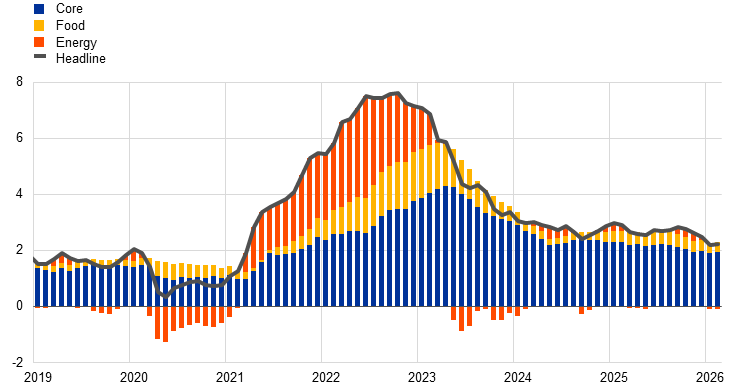
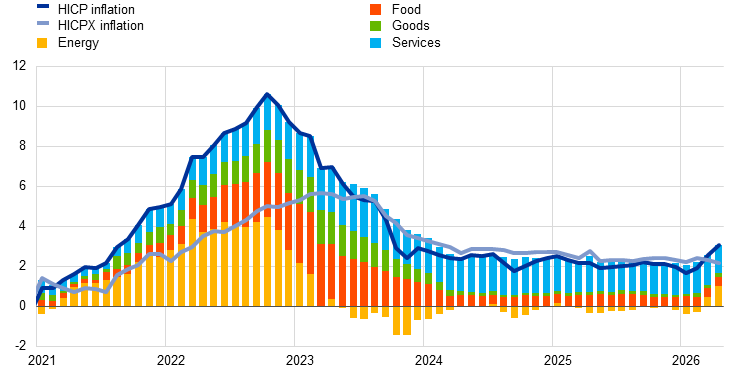
Annual euro area headline inflation, as measured in terms of the Harmonised Index of Consumer Prices (HICP), rose to 3.0% in April 2026, from 2.6% in March (Chart 8). This reflects a further increase in energy inflation and a modest increase in food inflation, only partly offset by a slight decline in HICP inflation excluding energy and food (HICPX). In the first quarter of 2026 euro area headline inflation stood at 2.0%, 0.1 percentage points below the March 2026 ECB staff macroeconomic projections for the euro area.
Chart 8
Headline inflation and its main components
(annual percentage changes; percentage point contributions)
Sources: Eurostat and ECB calculations.
Notes: “Goods” refers to non-energy industrial goods. HICPX stands for HICP excluding energy and food. The latest observations are for April 2026 (flash estimate).
Energy inflation rose sharply in April, to 10.9% from 5.1% in March. The increase was driven primarily by a strong month-on-month rise in energy prices (3.0%) and an upward base effect (around 2.7 percentage points). Data available up to March show an increase in the annual rate of inflation on the main energy sub-components, particularly transport and liquid fuels. HICP inflation excluding energy decreased to 2.2% in April from 2.3% in March.
Food inflation increased to 2.5% in April, from 2.4% in March. The increase was driven by unprocessed food inflation rising to 4.7% in April, from 4.2% in March, while processed food inflation was unchanged at 1.7%. In the coming months, indirect effects of the recent surge in energy costs may gradually start feeding through to food inflation.
HICPX inflation moderated to 2.2% in April, from 2.3% in March. The decline reflects a lower annual growth rate for services inflation (3.0% in April after 3.2% in March), only partially offset by the increase in non-energy industrial goods (NEIG) inflation (to 0.8% in April, from 0.5% in March). According to data up to March, the slowdown in services inflation was mainly driven by the decline in the annual growth rate for recreation services, primarily due to lower contributions from accommodation and, to a smaller extent, restaurant services. The subdued rate of NEIG inflation in March mainly reflected continued weak price pressures for semi-durable and durable goods.
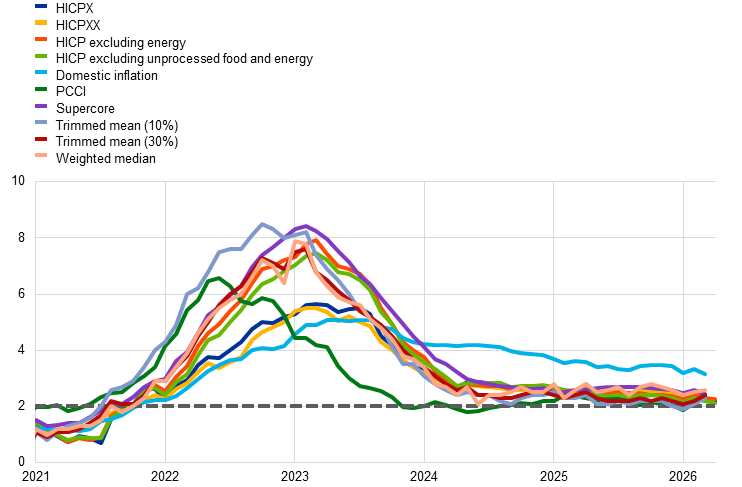
Underlying inflation indicators provided mixed signals in March compared with the previous month (Chart 9). These indicators ranged between 2.2% and 2.6% in March. Among the exclusion-based measures, HICP inflation excluding food and energy, travel-related items, clothing and footwear was unchanged, while the trimmed means increased by 0.2 percentage points. The remaining indicators declined by 0.1 percentage points. Regarding model-based indicators, the Persistent and Common Component of Inflation rose to 2.3% in March, from 2.1% in February. By contrast, the Supercore indicator, which comprises HICP items sensitive to the business cycle, edged down to 2.5% from 2.6%.[3] Domestic inflation, which comprises items with a low import content, also declined in March, to 3.1% from 3.3% in February. Data that are already available for April show that most exclusion-based measures fell by 0.1 percentage points compared with March. Overall, underlying inflation measures continued to point to broadly stabilising underlying price pressures.
Chart 9
Indicators of underlying inflation
(annual percentage changes)
Sources: Eurostat and ECB calculations.
Notes: HICPX stands for HICP excluding energy and food; HICPXX stands for HICPX excluding travel-related items, clothing and footwear; PCCI stands for the Persistent and Common Component of Inflation. The grey dashed line represents the Governing Council’s inflation target of 2% over the medium term. The latest observations are for April 2026 (flash estimate) for HICPX, HICP excluding energy and HICP excluding unprocessed food and energy, and March 2026 for the remaining measures.
Before the outbreak of the war in the Middle East, indicators of pipeline pressures had signalled subdued inflationary pressures for goods and food prices (Chart 10). At the early stages of the pricing chain, price pressures on intermediate goods remained moderate. Domestic producer price inflation eased slightly in February (1.3%), while import price inflation edged up (0.6%). At the later stages of the pricing chain, pipeline pressures on non-food consumer goods were broadly unchanged in February, with domestic producer price inflation stable at 1.6% and import price inflation still negative at -3.5%. At the same time, manufactured food producer price inflation turned negative in February (-0.2%) for the first time since May 2024. Import price inflation for manufactured food continued its persistent decline, falling to -3.7% in February. Overall, these dynamics reflect the past appreciation of the euro and possibly increased exports from China to the euro area market. As the data predate the start of the war in the Middle East, subsequent developments in producer prices and import prices are being closely monitored.
Chart 10
Indicators of pipeline pressures
(annual percentage changes)
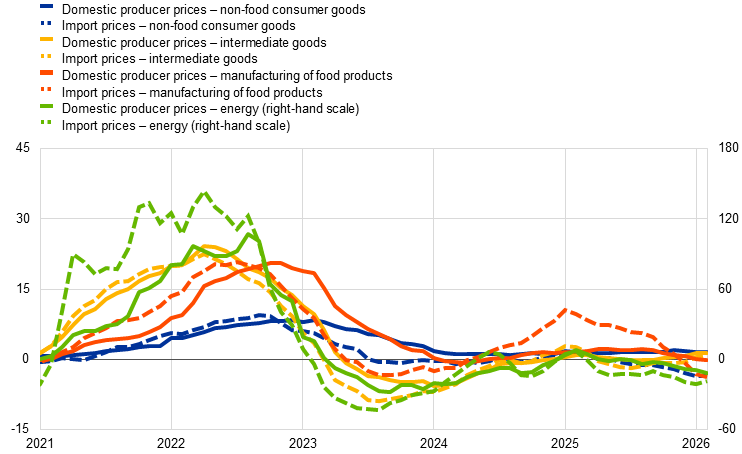
Sources: Eurostat and ECB calculations.
Note: The latest observations are for February 2026.
Domestic cost pressures, as measured by growth in the GDP deflator, increased to 2.6% in the fourth quarter of 2025, after having declined continuously until the beginning of that year (Chart 11). The increase reflects a higher contribution from unit profits, while contributions from unit labour costs and unit taxes were unchanged. In growth rate terms, unit labour costs remained at 3.1% in the fourth quarter of 2025, reflecting a decrease in the annual growth rate of compensation per employee (to 3.7% from 3.9%), which was partially offset by a decline in labour productivity growth (to 0.5% from 0.8%). The moderation in the growth rate of compensation per employee stemmed from a decline in the contribution from the wage drift component, to 0.4 percentage points from 1.9 percentage points in the previous quarter. This partially offset an increase in negotiated wage growth, to 3.0% from 1.9%. Looking ahead, the ECB wage tracker, which has been updated with data on wage agreements negotiated up to middle of April 2026, indicates that negotiated wage pressures will stabilise at 2.6% in 2026, having eased from 3.0% in 2025.[4] The moderation is also confirmed by the latest survey indicators on wage growth, such as the results of the ECB’s Corporate Telephone Survey, in which respondents expected wage growth to fall from 3.5% in 2025 to 2.9% in 2026 and 2.8% in 2027.[5]
Chart 11
Breakdown of the GDP deflator
(annual percentage changes; percentage point contributions)
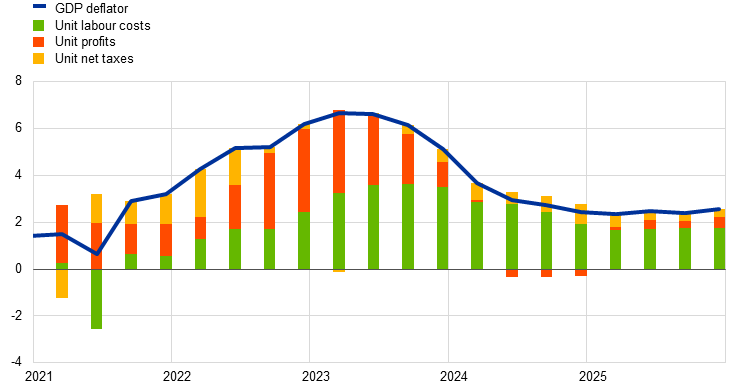
Sources: Eurostat and ECB calculations.
Notes: Compensation per employee contributes positively to changes in unit labour costs. Labour productivity contributes negatively. The latest observations are for the fourth quarter of 2025.
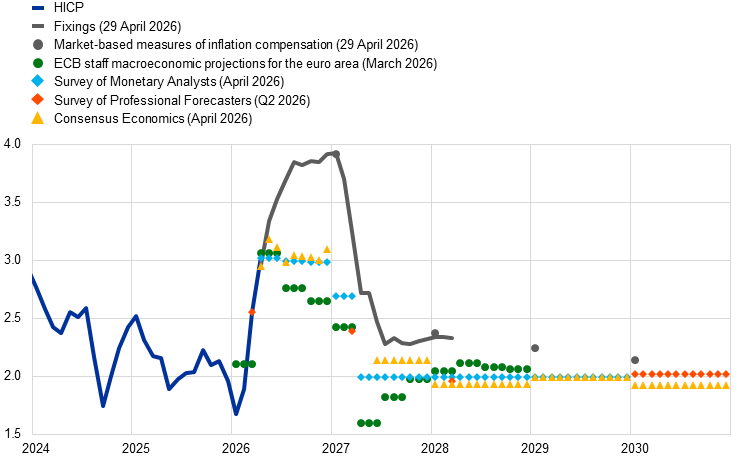
Shorter-term inflation expectations among professional forecasters, monetary analysts and consumers increased in March 2026. The median of longer-term inflation expectations in the ECB Survey of Monetary Analysts (SMA) for April 2026 and in the ECB Survey of Professional Forecasters (SPF) for the second quarter of 2026 were unchanged at 2% (Chart 12, panel a). By contrast, short-term inflation expectations were revised up, with the SMA expecting 2.8% and the SPF 2.7% in 2026, followed by a decline in 2027, to 2.2% for the SMA and 2.1% for the SPF. As regards short-term consumer inflation perceptions and expectations, the median rate of perceived inflation over the previous 12 months increased to 3.5% in the March 2026 ECB Consumer Expectations Survey (Chart 12, panel b), from 3.0% in February. Median expectations for inflation over the next 12 months and three years ahead jumped to 4.0% and 3.0% respectively, both from 2.5% in February. Median expectations for inflation five years ahead increased slightly, to 2.4% from 2.3%.
Chart 12
Headline inflation, inflation projections and expectations
a) Headline inflation, market-based measures of inflation compensation, inflation projections and survey-based indicators of inflation expectations
(annual percentage changes)
b) Headline inflation and ECB Consumer Expectations Survey
(annual percentage changes)
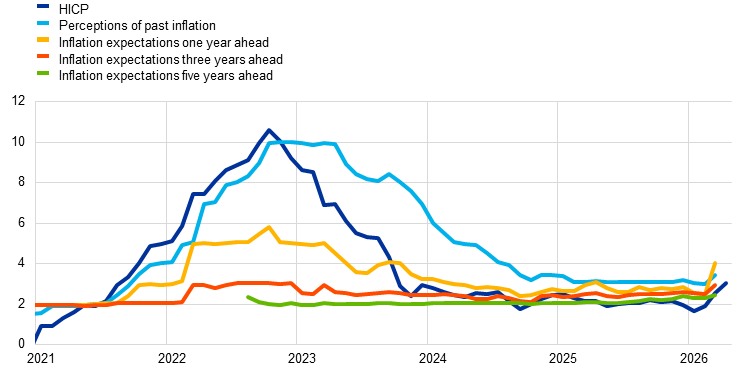
Sources: Eurostat, LSEG, Consensus Economics, ECB (SMA, SPF, CES), ECB staff macroeconomic projections for the euro area, March 2026 and ECB calculations.
Notes: In panel a), the market-based measures of inflation compensation series is based on the one-year spot inflation linked swap rate, the one-year forward rate one year ahead, the one-year forward rate two years ahead, the one-year forward rate three years ahead and the one-year forward rate four years ahead. The latest observations for the market-based measures of inflation compensation series and for fixings are for 29 April 2026. Inflation fixings are swap contracts linked to specific monthly releases of euro area year-on-year HICP inflation excluding tobacco. The SPF for the second quarter of 2026 was conducted between 31 March and 8 April 2026. The SMA for April 2026 was conducted between 13 and 15 April. The cut-off date for the Consensus Economics forecasts was 16 April 2026. The March 2026 ECB staff macroeconomic projections for the euro area were finalised on 13 March 2026, and the cut-off date for the technical assumptions was 11 March 2026. In panel b), the lines for the Consumer Expectations Survey (CES) represent the median rates. The latest observations are for April 2026 (flash estimate) for HICP and March 2026 for the remaining measures.
Over the review period from 19 March to 29 April, near-term market-based measures of inflation compensation increased, while longer-term expectations remained well anchored (Chart 12, panel a). The war in the Middle East triggered large swings in energy prices, inducing volatility in the pricing of the inflation outlook. Inflation fixings, which are swap contracts linked to the euro area HICP excluding tobacco, increased across horizons and currently imply that investors expect inflation to remain elevated over the coming year before easing to levels close to the Governing Council’s target by mid-2027. Looking beyond the near term, the one-year forward inflation-linked swap rate one year ahead increased by 26 basis points and stood at around 2.4% at the end of the review period. Longer-term market-based inflation expectations, as reflected in the five-year forward inflation-linked swap rate five years ahead, remained firmly anchored at around 2.0% once adjusted for inflation risk premia, supporting the stabilisation of inflation around the Governing Council’s target in the medium term.
4 Financial market developments
Financial markets in the euro area were marked by pronounced volatility during the review period from 19 March to 29 April 2026. Uncertainty surrounding the war in the Middle East triggered an initial risk-off repricing, which was followed by a broad-based recovery once a ceasefire was announced and then renewed volatility in the final days of the review period. Phases in which the conflict intensified were marked by rising energy prices and interest rates, a widespread decline in investor sentiment and sell-offs in risk assets, while there was a reversal of this pattern during periods of de-escalation. At the end of the review period, the risk-free forward curve suggested that markets were pricing in 83 basis points of cumulative interest rate hikes by year-end. Longer-term risk-free rates rose over the review period, while sovereign bond spreads were broadly unchanged. In spite of headwinds from geopolitical uncertainty and higher interest rates, risk assets performed strongly overall. Euro area equities ended the review period higher and investment-grade corporate bond spreads returned to their pre-war level. In foreign exchange markets, the euro strengthened against the US dollar (+1.9%) and was broadly stable in trade-weighted terms (+0.6%).
Euro area risk-free rates increased over the review period at both short and long-term maturities, with the forward curve remaining well above the levels prevailing before the outbreak of the war in the Middle East. The benchmark euro short-term rate (€STR) stood at 1.93% at the end of the review period, following the Governing Council’s decision at its meeting on 19 March 2026 to keep the three key ECB interest rates unchanged. Excess liquidity decreased by around €101 billion to €2,263 billion, which mainly reflected the continuing decline in the portfolios of securities held for monetary policy purposes. As concerns over a prolonged conflict eased following the ceasefire announcement on 8 April, near-term forward rates fell significantly. However, movements over the last part of the review period reversed this decline, shifting the €STR forward curve upwards versus the start of the review period and further above pre-war levels. At the end of the review period, the €STR forward curve implied that markets were pricing in cumulative interest rate hikes of 83 basis points by the end of the year, up from 71 basis points priced in at the start of the review period on 19 March. The forward curve also shifted up materially at horizons beyond 2026. Overall, the ten-year nominal overnight index swap (OIS) rate rose by 15 basis points, ending the review period at around 2.9%.
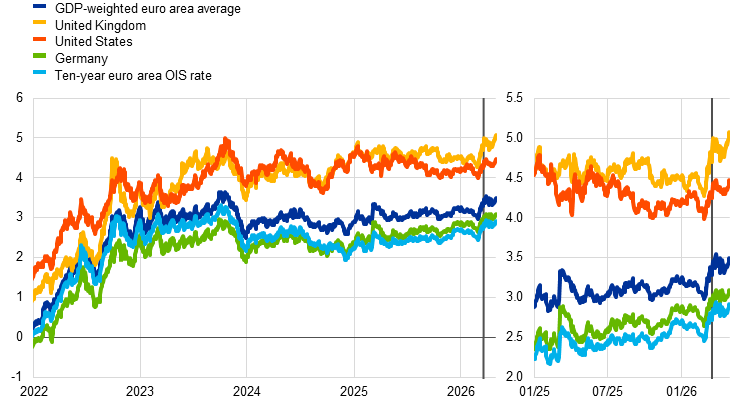
Long-term euro area sovereign bond yields rose broadly in line with risk-free rates over the review period, while yield spreads remained largely unchanged (Chart 13). Euro area sovereign bonds experienced a marked repricing at the start of the war in the Middle East, with yields rising sharply amid inflation concerns linked to higher energy prices. This upward momentum extended into the review period but was subsequently partly unwound following the ceasefire announcement on 8 April. The uptick observed in the final days of the review period was broadly in line with the repricing in risk-free rates. Overall, the ten-year GDP-weighted euro area sovereign bond yield increased by 13 basis points, closing the review period at around 3.5%, with spreads relative to the OIS rate at the same maturity narrowing marginally. In the United States, the ten-year Treasury yield rose by 18 basis points to stand at around 4.5% at the end of the review period, while the ten-year UK sovereign bond yield went up by 23 basis points to around 5.1%.
Chart 13
Ten-year sovereign bond yields and the ten-year OIS rate based on the €STR
(percentages per annum)
Sources: LSEG and ECB calculations.
Notes: The vertical grey line denotes the start of the review period on 19 March 2026. The latest observations are for 29 April 2026.
While euro area equity markets regained some ground over the review period, equity prices remained lower than before the outbreak of the war. The Middle East ceasefire announcement shored up euro area equities and initially triggered a full recovery from the losses sparked by the outbreak of the war, but this was not sustained until the end of the review period. The broad euro area stock market index went up by 4.3%, with financial sector stocks advancing by 7.5% and the sub-index for non-financial corporations (NFCs) rising by 2.6%. In the United States, the S&P 500 gained 7.7% over the review period, with the NFC and financial sector indices increasing by 8.1% and 5.6% respectively. This recovery in equity markets on both sides of the Atlantic suggests that global equity valuations were supported by common factors, in particular the tentative improvement in risk sentiment despite continued geopolitical uncertainty, alongside a rebound in artificial intelligence stocks. At the same time, the relative underperformance of euro area equities reflected their higher exposure to the Middle East conflict, particularly in the case of NFCs.
Euro area corporate bond markets also reflected the fragile improvement in risk sentiment, with spreads tightening over the review period. The Middle East ceasefire announcement on 8 April reduced geopolitical uncertainty and reversed the widening in corporate bond spreads that had followed the outbreak of the war. Investment-grade corporate bond spreads tightened by 9 basis points over the review period, returning to their pre-war level. By contrast, spreads in the high-yield segment declined by 28 basis points but remained approximately 6 basis points above their pre-conflict level.
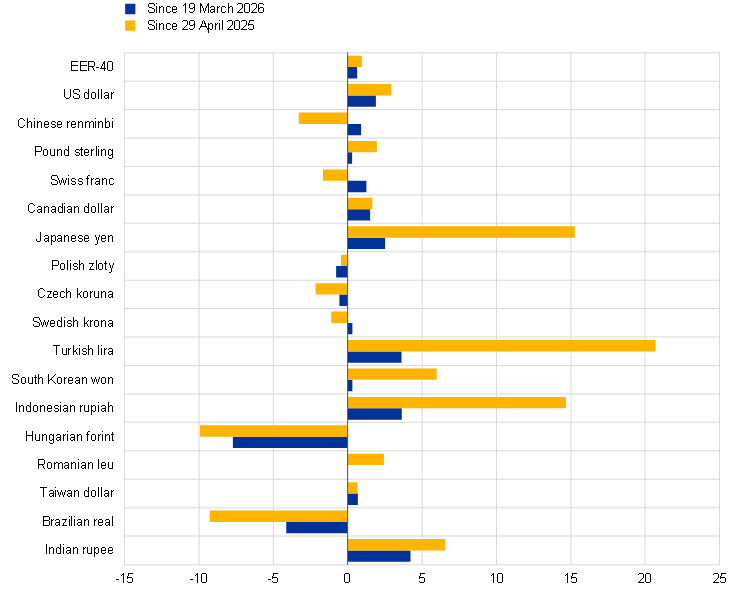
In foreign exchange markets, the euro appreciated against the US dollar and was broadly stable in trade-weighted terms (Chart 14). The nominal effective exchange rate of the euro – as measured against the currencies of 40 of the euro area’s most important trading partners – increased by a marginal 0.6% over the review period. This relative stability reflected broadly counterbalancing movements against several of these currencies. Notably, the euro appreciated against the US dollar (+1.9%) following ceasefire negotiations between the United States and Iran, approaching its pre-war level of USD 1.18 per euro. It also appreciated against the Chinese renminbi (+0.9%), which is closely linked to the US dollar, the Swiss franc (+1.3%), the Japanese yen (+2.5%) and the Turkish lira (+3.6%), while remaining broadly stable against the pound sterling (+0.3%). By contrast, the euro depreciated against the Hungarian forint (‑7.7%), following the Hungarian parliamentary elections, and the Brazilian real (‑4.1%).
Chart 14
Changes in the exchange rate of the euro vis-à-vis selected currencies
(percentage changes)
Source: ECB calculations.
Notes: EER-40 is the nominal effective exchange rate of the euro against the currencies of 40 of the euro area’s most important trading partners. A positive (negative) change corresponds to an appreciation (depreciation) of the euro. All changes have been calculated using the foreign exchange rates prevailing on 29 April 2026.
5 Financing conditions and credit developments
Financing conditions for firms and households were broadly stable up to February 2026 but have become tighter since the outbreak of the war in the Middle East. In February bank lending rates for firms edged down to 3.5%, while the average interest rate on new mortgages remained at 3.4%. Over the review period from 19 March to 29 April 2026, the cost to non-financial corporations of market-based debt remained virtually unchanged despite higher risk-free rates, while the cost of equity increased, as did bank bond yields. Growth in loans to firms increased in March, while growth in loans to households was stable. The annual growth rate of broad money (M3) increased marginally to 3.2%. According to the April 2026 euro area bank lending survey, banks further tightened credit standards for loans to firms in the first quarter of 2026, and demand for new loans to firms declined slightly. Credit standards for housing loans tightened slightly and those for consumer credit tightened further. Demand for housing loans remained unchanged, while consumer credit demand contracted significantly. In the Survey on the Access to Finance of Enterprises for the first quarter of 2026, firms reported an increase in bank interest rates and a continued tightening of other lending conditions.
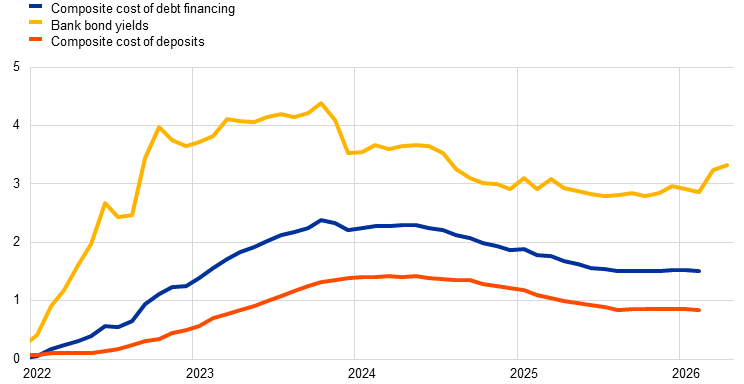
Bank funding costs remained broadly stable until February 2026, but bank bond yields increased markedly in March. In February the composite cost of debt financing for euro area banks stood at 1.5%, having stayed at this level since July 2025 (Chart 15). Bank bond yields were stable, hovering at around 3% since early 2025. However, they increased markedly following the outbreak of the war in the Middle East on 28 February, primarily reflecting higher medium to long-term risk-free rates (see Section 4, “Financial market developments”). The composite deposit rate remained unchanged at 0.9% in February. Interest rates on overnight deposits and deposits redeemable at notice saw little change, as did interbank rates, while rates on savings accounts decreased slightly.
Chart 15
Composite bank funding costs in the euro area
(annual percentages)
Sources: ECB, S&P Dow Jones Indices LLC and/or its affiliates, and ECB calculations.
Notes: The composite cost of debt financing is an average of new business costs for banks for overnight deposits, deposits redeemable at notice, time deposits, bonds and interbank borrowing, weighted by their respective outstanding amounts. The composite cost of deposits is calculated as the average of new business rates on overnight deposits, deposits with an agreed maturity and deposits redeemable at notice, weighted by their respective outstanding amounts. The latest observations are for February 2026 for the composite cost of debt financing and the composite cost of deposits, and 29 April 2026 for bank bond yields.
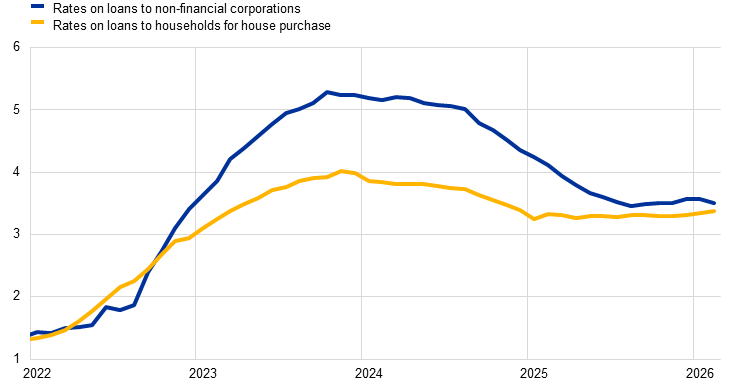
Bank lending rates for firms fell slightly in February, while those for households were stable (Chart 16). The cost of bank borrowing for non-financial corporations decreased to 3.5% in February, from 3.6% in January, standing around 1.8 percentage points below its October 2023 peak. This was driven by a decline in rates on short-term loans (up to one year), while rates on medium-term and longer-term loans (over one year) increased. The spread between interest rates on small and large loans to firms rose somewhat in February, mostly on the back of falling rates on large loans, while rates on small loans increased. The cost of borrowing for households for house purchase was unchanged at 3.4% in February and stood around 70 basis points below its November 2023 peak. Across rate fixation periods, the picture was mixed: rates increased for mortgages with longer-term fixation periods (over five years), remained unchanged for those with medium-term fixation periods (between one and five years) and decreased for shorter-term loans (below one year).
Chart 16
Composite bank lending rates for firms and households in the euro area
(annual percentages)
Sources: ECB and ECB calculations.
Notes: Composite bank lending rates are calculated by aggregating short and long-term rates using a 24-month moving average of new business volumes. The latest observations are for February 2026.
Over the review period from 19 March to 29 April 2026, there was no change in the cost of firms’ market-based debt, while the cost of equity financing increased. The overall cost of financing for non-financial corporations – the composite cost of bank borrowing, market-based debt and equity – remained unchanged in February, at 5.8% for the fourth consecutive month (Chart 17).[6] A 10 basis point increase in the long-term cost of bank borrowing was compensated by slight declines in all other components of the overall cost of financing. Daily data for the review period show an increase in the cost of equity financing and virtually no change in the cost of market-based debt. The increase in the cost of equity almost exclusively reflected a higher equity risk premium, while the stability in the cost of market-based debt was due to the compression of corporate spreads – especially in the high-yield sector – which offset the slight rise in long-term risk-free rates.
Chart 17
Nominal cost of external financing for euro area firms, broken down by component
(annual percentages)
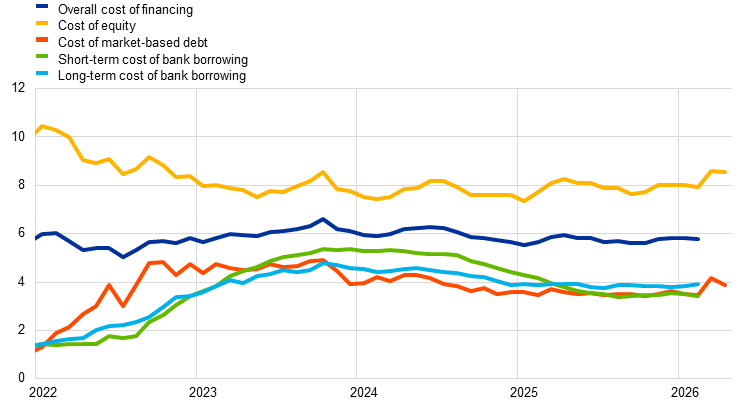
Sources: ECB, Eurostat, Dealogic, Merrill Lynch, Bloomberg Finance L.P., LSEG and ECB calculations.
Notes: The overall cost of financing for non-financial corporations is based on monthly data and is calculated as an average of the long and short-term costs of bank borrowing (monthly average data) and the costs of market-based debt and equity (end-of-month data), weighted by their respective outstanding amounts. The latest observations are for 29 April 2026 for the cost of market-based debt and the cost of equity (daily data), and February 2026 for the overall cost of financing and the long-term and short-term cost of borrowing from banks (monthly data).
Growth in loans to firms increased in March, while growth in loans to households remained stable (Chart 18). The annual growth rate of bank lending to non-financial firms rose to 3.2% in March, from 3.0% in February, but remained well below its historical average of 4.3% since the start of the time series in 1999. The issuance of debt securities by firms fell to 3.9%, from 4.5% in February, as issuance costs initially surged following the outbreak of the war in the Middle East. This kept the annual growth rate of debt financing by firms broadly stable in March, at 3.4%. Growth in longer‑term loans weakened, reflecting lower loan demand for investment purposes. The annual growth rate of loans to households was stable at 3.0% in March, also remaining well below its historical average of 4.1%. The growth in loans to households was mainly supported by growth in consumer credit and, to a lesser extent, in mortgages, while other forms of lending to households, including loans to sole proprietors, remained weak. According to the ECB Consumer Expectations Survey for March 2026, the war in the Middle East has adversely affected household expectations regarding credit access, which in March were at their tightest level since the peak of the last policy rate hiking cycle in December 2023.
Chart 18
MFI loans in the euro area
(annual percentage changes)
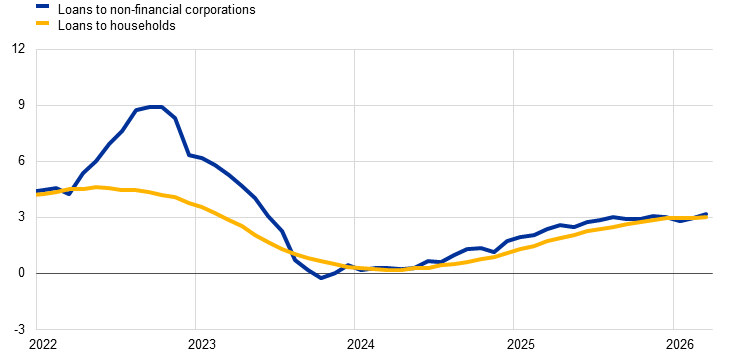
Sources: ECB and ECB calculations.
Notes: Loans from monetary financial institutions (MFIs) are adjusted for loan sales and securitisation; in the case of non-financial corporations, loans are also adjusted for notional cash pooling. The latest observations are for March 2026.
The April 2026 euro area bank lending survey reports a further tightening of credit standards for loans to firms in the first quarter of 2026 and a small tightening of credit standards for housing loans (Chart 19). The tightening of credit standards for loans or credit lines to euro area firms was larger than previously expected by banks. It stood above the historical average and represented the most pronounced tightening since the third quarter of 2023, extending a continued cumulative tightening trend that began in mid-2025. Higher perceived risks to the economic outlook and lower risk tolerance on the part of banks were the main contributing factors. Some banks reported additional tightening as a result of exposures to energy-intensive firms and to the Middle East. Credit standards for housing loans tightened slightly, and those for consumer credit tightened further in the first quarter of 2026. For housing loans, risk perceptions had a tightening impact on credit standards, while competition had a small easing effect. For consumer credit, the lower risk tolerance and higher risk perceptions of banks were the main drivers of the tightening. For the second quarter of 2026, euro area banks expect credit standards to tighten markedly for loans to firms, while credit standards are expected to tighten further for both housing loans and consumer credit.
Chart 19
Changes in credit standards and net demand for loans to NFCs and loans to households for house purchase
(net percentages of banks reporting a tightening of credit standards or an increase in loan demand)
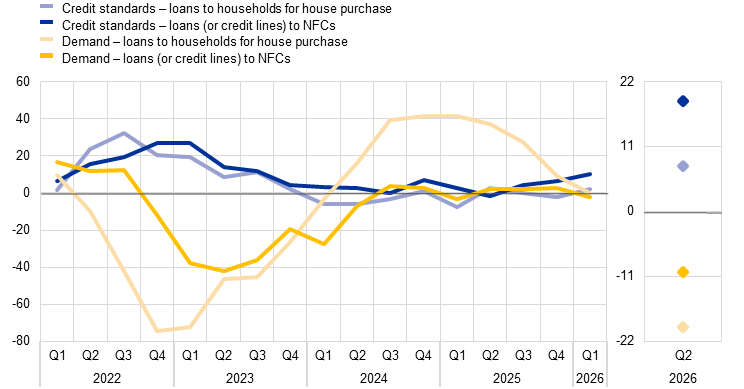
Source: ECB (bank lending survey).
Notes: NFCs stands for non-financial corporations. For survey questions on credit standards, “net percentages” are defined as the difference between the sum of the percentages of banks responding “tightened considerably” and “tightened somewhat” and the sum of the percentages of banks responding “eased somewhat” and “eased considerably”. For survey questions on demand for loans, “net percentages” are defined as the difference between the sum of the percentages of banks responding “increased considerably” and “increased somewhat” and the sum of the percentages of banks responding “decreased somewhat” and “decreased considerably”. The diamonds denote expectations reported by banks in the current round. The latest observations are for the first quarter of 2026.
Banks reported that demand for loans to firms declined slightly in the first quarter of 2026, while demand for housing loans remained unchanged and demand for consumer credit decreased considerably. The decrease in demand for loans to firms was unexpected, as in the previous survey round banks had anticipated a moderate increase similar to the increases observed in the preceding three consecutive quarters. The drop in demand for loans was driven mainly by a decrease in demand for fixed investment and was partially offset by higher demand for inventories and working capital, primarily among small and medium-sized enterprises (SMEs). While demand for housing loans was unchanged, demand for consumer credit decreased markedly. In the previous survey round, banks had expected stronger demand in both categories. Deteriorating consumer confidence and developments in interest rates weighed on demand for housing loans. Weaker spending on durable goods and lower consumer confidence, as well as the general level of interest rates, contributed to the weak demand for consumer credit. For the second quarter of 2026, banks expect a more pronounced net decrease in demand for loans to firms and further declines in demand for housing loans and consumer credit.
According to the responses of banks to the ad hoc questions in the survey, their access to funding deteriorated further, while risks to credit quality also had a tightening impact on credit standards. In the first quarter of 2026 the ease with which banks were able to access debt securities, money markets and securitisations deteriorated, while it remained broadly unchanged for retail funding. Over the next three months, banks expect access to debt securities, money market funding and securitisation markets to deteriorate further, with access to retail funding aligning with this trend. Banks reported a net tightening impact of non-performing loans ratios and other credit quality indicators on their credit standards for loans to firms and consumer credit in the first quarter of 2026, while credit standards for housing loans were broadly unaffected. Banks indicated that higher risk perceptions, lower risk tolerance, pressure stemming from supervisory or regulatory requirements and costs related to balance sheet clean-up operations had contributed to the net tightening. For the second quarter of 2026, euro area banks expect credit quality to have a further tightening impact on their credit standards for loans to firms and, more markedly, for consumer credit. In response to a new question on the securitisation activities of banks and their impact on lending, nearly half of euro area banks reported using either traditional or synthetic securitisation. Euro area banks identified freeing up capital to issue new loans as their primary motivation for securitising loans, followed by improving their liquidity position, managing credit risks, improving access to funding and meeting regulatory or supervisory requirements.
In the latest Survey on the Access to Finance of Enterprises (SAFE), conducted between 19 February and 1 April 2026, firms reported a tightening in bank lending conditions amid increases in bank interest rates. In the first quarter of 2026 a net 26% of firms reported an increase in bank interest rates, compared with a net 12% in the previous quarter. SMEs and large firms reported similar perceptions regarding the rise in interest rates. Firms also indicated a further net tightening of other loan conditions, particularly for other financing costs, such as charges, fees and commissions and collateral requirements.
Firms reported unchanged needs for bank loans, accompanied by a marginal decrease in availability (Chart 20). In the first quarter of 2026 firms indicated unchanged needs for bank loans, while a net 3% of firms reported a decline in the availability of bank loans (up from 2% in the previous quarter), with similar results observed for both SMEs and large firms. The bank loan financing gap indicator – an index capturing the difference between changes in perceived needs and availability – remained positive for a net 2% of firms, although this figure is slightly lower than in the previous quarter (net 3%), thus continuing to signal that needs exceed availability. Looking ahead, firms expect the availability of external financing to decrease marginally over the next three months, marking a less optimistic outlook than in the previous survey round. Firms surveyed before and after the outbreak of the war in the Middle East reported similar expectations for bank loan availability over the next three months. However, expectations for bank loan availability over the next six months were notably lower among firms that were surveyed after the outbreak of the war compared with firms surveyed before that.
Chart 20
Changes in needs of euro area firms for loans, current and expected bank loan availability and financing gap
(net percentages of respondents)
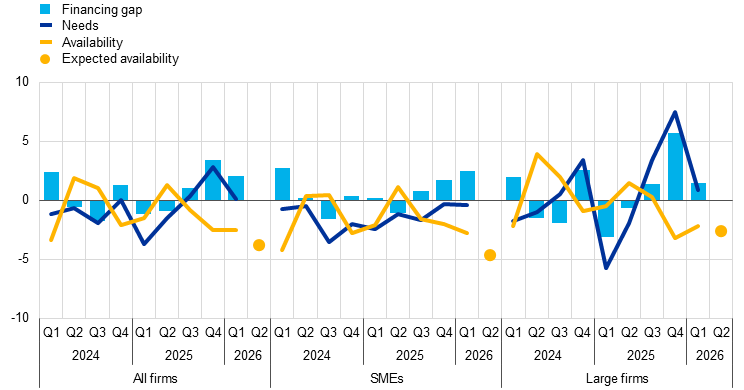
Sources: ECB (SAFE) and ECB calculations.
Notes: SMEs stands for small and medium-sized enterprises. Net percentages are the difference between the percentage of firms reporting an increase in the availability of bank loans (or needs and expected availability respectively) and the percentage reporting a decrease in availability in the past three months. The indicator of the perceived change in the financing gap takes a value of 1 (-1) if the need increases (decreases) and availability decreases (increases). If firms perceive only a one-sided increase (decrease) in the financing gap, the variable is assigned a value of 0.5 (-0.5). A positive value for the indicator points to a widening of the financing gap. Values are multiplied by 100 to obtain weighted net balances in percentages. Expected availability has been shifted forward by one period to allow a direct comparison with realisations. The figures refer to rounds 30 to 38 of the SAFE (January-March 2024 to January-March 2026).
The annual growth rate of broad money (M3) increased marginally in March amid robust net foreign inflows into the euro area (Chart 21). Annual growth in M3 rose to 3.2% in March, from 3.0% in February, but remained well below its historical average of 5.2% since the start of the time series in 1999. The increase in broad money growth was supported by inflows into marketable instruments and a stronger preference for liquid assets, especially among non-bank financial intermediaries. However, strong declines in household deposits meant that the annual growth rate of narrow money (M1) – comprising the most liquid instruments, namely currency in circulation and overnight deposits – fell from 4.8% in February to 4.6% in March. From a counterpart perspective, robust net foreign monetary inflows into the euro area and bank purchases of (shorter-term) government bonds were the main contributors to the increase in money creation. By contrast, the reduction of the Eurosystem balance sheet continued to weigh on M3 growth, given that the principal payments from maturing securities in the asset purchase programme and pandemic emergency purchase programme portfolios are no longer being reinvested.
Chart 21
M3, M1 and overnight deposits
(annual percentage changes, adjusted for seasonal and calendar effects)
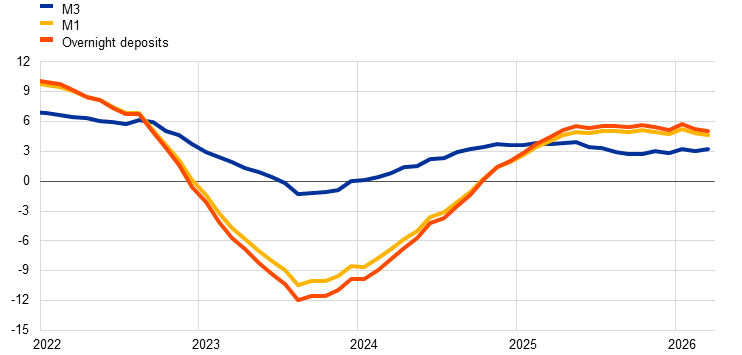
Source: ECB.
Note: The latest observations are for March 2026.
1 Assessing cross-border integration of equity markets in the euro area: evidence from a gravity model
Prepared by Pablo Anaya Longaric, Lisa Bellinghausen, Laura Parisi, Lucia Quaglietti and Fons van Overbeek
Despite some progress on integration, euro area financial markets remain fragmented. The EU savings and investments union aims to remove barriers to cross-border capital flows, unlocking investment, lowering the cost of capital and strengthening resilience. However, the scale of remaining frictions is difficult to quantify. This box addresses this gap by applying a structural gravity model to bilateral euro area equity holdings, providing estimates of the changes in financial frictions in equity markets over the past decade.
More2 The impact of China’s industrial rise on the euro area
Prepared by Alessandra Amicucci, Nicolò Gnocato, Vanessa Gunnella, Clara Lindemann, Alfonso Merendino and Carlos Montes-Galdón
China’s industrial rise is a key external force influencing euro area trade, production and prices by reducing costs and increasing competitive pressures for euro area producers. The recent expansion of exports from China reflects productivity gains and technological advances that are strengthening the role of China in higher-value manufacturing, although other factors, such as lower Chinese demand for imports, are also at play.[7] For euro area producers, import penetration by Chinese competitors can exert expansionary effects through lower input costs and prices, but can also displace production through stronger competition.
More3 Dispersion in real GDP growth across euro area countries: developments and drivers
Prepared by Niccolò Battistini, Johannes Gareis and Richard Morris
Dispersion in euro area real GDP growth has declined recently and is relatively low by historical standards. Cross-country dispersion in euro area real GDP growth – measured as the GDP-weighted sum of absolute deviations of each country’s quarterly year-on-year growth from that of the euro area aggregate (excluding Ireland) – is now at a relatively low level.[8] Such a level has typically been associated with “calm” periods, including the period preceding the global financial crisis (1999-2007) and the period following the euro area sovereign debt crisis but preceding the COVID-19 pandemic (2015-19) (Chart A). However, dispersion in real GDP growth has only recently fallen from the elevated levels observed during the pandemic and in the wake of the Russian invasion of Ukraine.
More4 Save your energy: how the war in the Middle East could affect household savings and the economy
Prepared by Niccolò Battistini, Alina Bobasu, Rodolfo Dinis Rigato and Hanno Kase
Rising energy prices and heightened consumer uncertainty related to the war in the Middle East have renewed risks to the outlook for the household saving rate. After declining from its post-pandemic peak, the saving rate increased rapidly in 2022 and 2023 and has remained elevated since 2024, standing above its highest pre-pandemic level (Chart A). This has largely been on account of strong real income growth and subdued domestic demand amid declining real energy prices and uncertainty after the previously high levels triggered by Russia’s invasion of Ukraine. However, as the economic repercussions of the war in the Middle East unfold, recent trends in energy prices and uncertainty may reverse, with implications for the saving rate. Against this backdrop, this box assesses how alternative paths for the terms of trade (closely tracking real energy prices) and for consumer uncertainty could affect the saving rate, as well as their distributional and macroeconomic consequences.
More5 What drives employment trends among older workers?
Prepared by Nina Furbach and Afonso S. Moura
The euro area is undergoing sizeable demographic changes that are visible even in the shorter run, with significant implications for employment. Demographic changes do not just affect the economy in the long term, they can also influence short-term labour market developments. Ageing leads to noticeable changes in age distribution, even over relatively short periods of time (Chart A). Employment rates vary across age groups, with those among older people being lower on average. This means that, in an ageing economy, compositional shifts within the working-age population mechanically affect aggregate employment rates.[9] At the same time, changes in statutory retirement ages, rising life expectancy and improving health at later stages of life increase labour market attachment.[10]
More6 Main findings from the ECB’s recent contacts with non‑financial companies
Prepared by Catherine Elding, Friderike Kuik, Aidan Meyler and Richard Morris
This box summarises the main findings from recent contacts between ECB staff and representatives of 67 leading non-financial companies operating in the euro area. The exchanges mainly took place between 23 March and 1 April 2026.[11]
Contacts reported good business momentum in the first quarter with few signs as yet of demand reacting to the war in the Middle East. While a few contacts noted a slow start to the year, activity was generally said to be good or improving in the first quarter, broadly in line with – or above – prior expectations. Growth was still being driven mainly by services, but orders and production were also steadily picking up in manufacturing and construction. Beyond specific areas of disruption directly linked to developments in the Middle East (i.e. sales in/to and travel to/from/via the region), as of late March incoming orders did not point to a related softening of activity yet.
More7 What’s new in the HICP? The 2026 classification update and its implications for inflation analysis
Prepared by Martin Eiglsperger, Katalin Bodnár, Rania Bouhaouita Haddad and Elisabeth Wieland
The January 2026 release of the HICP introduced a major change in how consumer products are classified. The HICP, which the European Central Bank (ECB) uses as its principal measure of inflation in the euro area, serves as a yardstick for assessing price stability, the ECB’s primary monetary policy objective. A key feature of the HICP is the availability of detailed price indices by product – with products classified according to their consumption purpose – and predefined aggregate indices, for example, for food (unprocessed and processed), energy, non-energy industrial goods and services. The HICP classification is based on the Classification of Individual Consumption according to Purpose (COICOP), which was introduced in 1999 and later refined at the European level as European COICOP (ECOICOP).[12] A comprehensive update has been made to the HICP as of January 2026, aligning the European classification with the international COICOP 2018 standard to establish ECOICOP version 2. In addition, the index reference year for the HICP has changed from 2015 = 100 to 2025 = 100. The euro area aggregate has also been extended to include Bulgaria, following its entry into the euro area on 1 January 2026.[13]
More1 Tariffs and foreign direct investment – a nuanced relationship
Prepared by Isabella Moder, Tajda Spital, Virginia Di Nino, Lorenz Emter and Michael Fidora
Tariffs have re-emerged as a key policy tool amid rising protectionism, sparking debates about their impact on foreign direct investment (FDI). While traditionally associated with restricting trade and protecting domestic industries, tariffs have recently been used by some countries, including the United States, as part of a broader industrial strategy.[14] Such strategic measures seek to reshape global production patterns, enhance economic resilience and address geopolitical fragmentation by seeking to attract inward FDI into the tariff-imposing country.[15] However, the effectiveness of tariffs in attracting FDI, especially in the manufacturing sector, is still disputable given the mixed evidence in the empirical literature.
More2 Drivers of the labour force in the euro area
Prepared by Agostino Consolo, António Dias da Silva, Nina Furbach and Ramon Gomez-Salvador
The euro area labour force has expanded significantly in recent years, driven by rising participation rates, demographic shifts and sustained net migration. The labour force comprises all individuals of working age – which we define as those aged 15 to 74 to account for longer working lives – who are either in employment or actively seeking work. The share of the working-age population participating in the labour force, known as the “participation rate”, has increased across multiple dimensions in recent years: the share of women in employment has risen, narrowing long-standing gender gaps; older workers have remained active for longer, partly reflecting pension reforms and a secular shift towards less physically demanding occupations; and successive cohorts with higher educational qualifications have entered the labour force, which supports labour force expansion given that the higher educated tend to have higher participation rates. Alongside these domestic trends, net migration has been persistently positive since around 2010, with non-EU workers becoming an increasingly important driver of labour force growth.
More https://www.ecb.europa.eu/pub/pdf/ecbu/ecb.eb_annex202603~791d2b79ee.en.pdf© European Central Bank, 2026
Postal address 60640 Frankfurt am Main, Germany
Telephone +49 69 1344 0
Website www.ecb.europa.eu
All rights reserved. Reproduction for educational and non-commercial purposes is permitted provided that the source is acknowledged.
For specific terminology please refer to the ECB glossary (available in English only).
The cut-off date for the statistics included in this issue was 29 April 2026.
PDF ISSN 2363-3417, QB-01-26-051-EN-N
HTML ISSN 2363-3417, QB-01-26-051-EN-Q
Legal Disclaimer:
EIN Presswire provides this news content "as is" without warranty of any kind. We do not accept any responsibility or liability for the accuracy, content, images, videos, licenses, completeness, legality, or reliability of the information contained in this article. If you have any complaints or copyright issues related to this article, kindly contact the author above.
