

Dairy Processing Equipment Market to Reach US$ 19.1 Billion by 2033, Growing at 6.3% CAGR
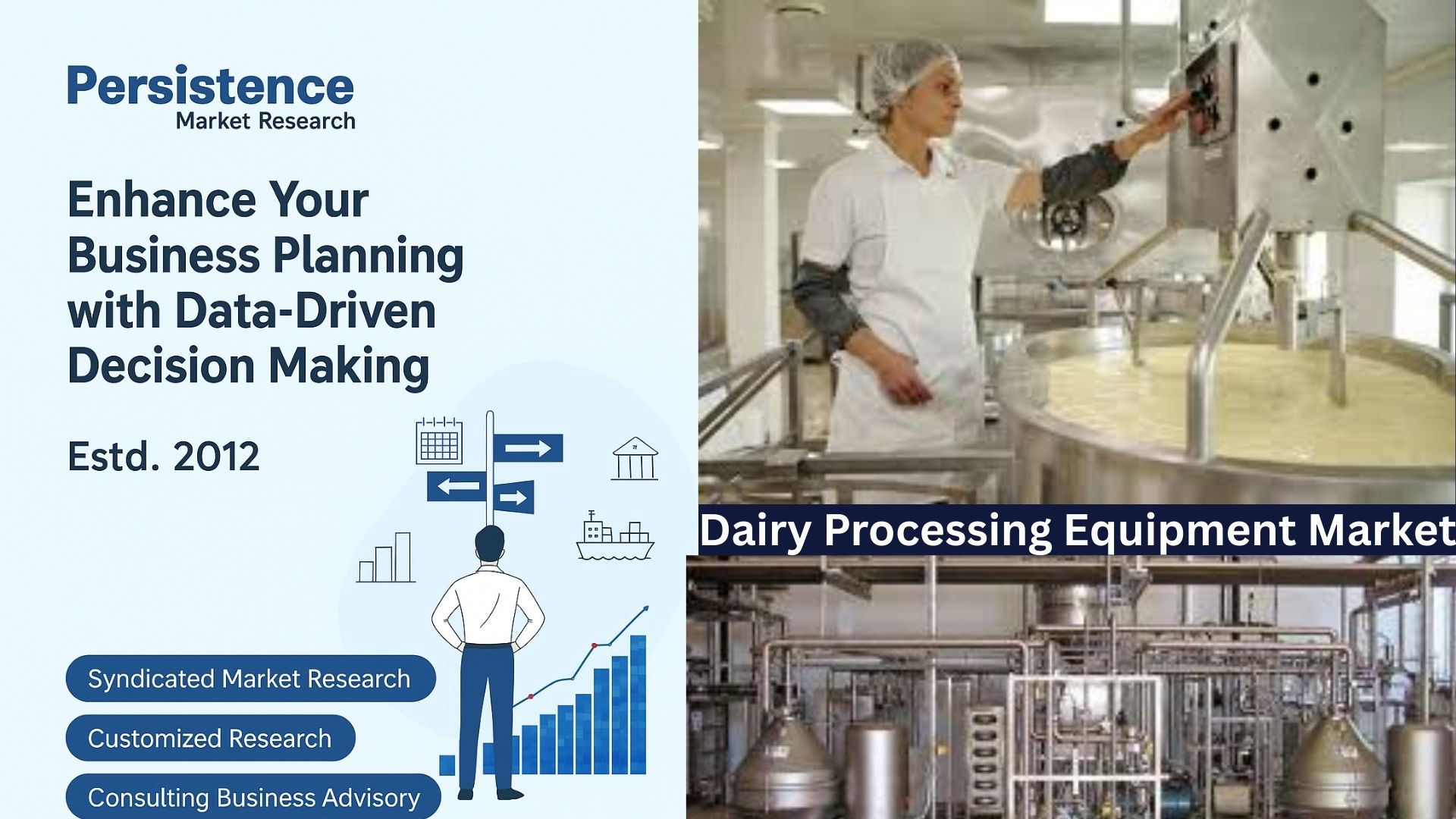
Dairy Processing Equipment Market Outlook
Driven by Rising Global Dairy Consumption, Automation in Processing Plants, and Technological Advancements Enhancing Efficiency and Product Quality
BRENTFORD, ENGLAND, UNITED KINGDOM, February 25, 2026 /EINPresswire.com/ -- The global dairy processing equipment market is on a robust growth trajectory. The market size is expected to reach US $19.1 billion by 2033, up from an estimated US $12.4 billion in 2026, reflecting a compound annual growth rate (CAGR) of 6.3 % over the 2026–2033 period. Market expansion is driven by rising dairy consumption from population growth and urbanization, stringent FDA and PMO food safety regulations requiring advanced pasteurization, and accelerating automation investments, modernizing processing facilities. North America grows at 5.5% CAGR through innovation leadership, Europe holds 24% share via manufacturing heritage and sustainability focus, while Asia Pacific leads with 37% share driven by infrastructure development.
➤ Download Your Free Sample & Explore Key Insights: https://www.persistencemarketresearch.com/samples/34880
Dairy processing equipment encompasses a broad range of machinery and systems used in milk and dairy product processing—from pasteurizers and separators to membrane filtration units and storage tanks. These technologies are foundational to the modernization of dairy processing operations worldwide, enabling producers to meet quality, safety, and efficiency standards in an increasingly competitive market.
Drivers of Market Expansion
Several powerful forces are driving the growth of the dairy processing equipment market:
Rising Global Dairy Consumption
Global demand for dairy products continues to grow, propelled by population growth, rising disposable incomes, and urbanization. As consumer preferences evolve, there is heightened demand not only for staple products like liquid milk and yogurt but also for value added variants such as flavored milk, probiotic dairy, lactose free options, and fortified beverages. This broadening product spectrum necessitates advanced processing equipment capable of handling diversified production requirements.
Regulatory and Food Safety Requirements
Food safety regulations in major markets—including stringent guidelines set by authorities like the FDA (U.S. Food and Drug Administration) and PMO (Pasteurized Milk Ordinance)—are encouraging dairy processors to adopt modern equipment capable of precise temperature control and hygienic processing. Compliance with such regulations ensures product integrity and consumer safety, further stimulating equipment investments.
Automation and Technological Advancements
Automation is increasingly becoming a competitive differentiator in dairy processing. Automated systems enhance operational efficiency, reduce labor dependency, and support continuous, high volume production. A significant portion of the market is now dominated by automatic processing systems, reflecting the industry’s shift toward end to-end mechanization.
In addition, advanced membrane filtration technologies—such as ultrafiltration, nanofiltration, and reverse osmosis—are gaining traction due to their ability to improve protein recovery, water efficiency, and energy savings.
By Equipment Type
Pasteurizers
Separators & Centrifuges
Homogenizers
Evaporators & Dryers
Membrane Filtration Equipment
Mixers & Blenders
Storage Tanks & Others
By Operation Type
Automatic
Semi-Automatic
By Application
Liquid Milk & Processed Milk
Cheese
Yogurt & Fermented Dairy
Butter & Cream
Milk Powder & Infant Formula
Protein Ingredients & Functional Dairy
Others
By Region
North America
Europe
East Asia
South Asia and Oceania
Latin America
Middle East and Africa
➤Customize This Report for Your Exact Requirements: https://www.persistencemarketresearch.com/request-customization/34880
Regional Trends
The global market is geographically diverse, with notable regional variations in growth and adoption:
• Asia Pacific is the largest market by share, driven by rapid economic development, rising dairy consumption, and growing investments in processing infrastructure. Countries like China and India—both with substantial dairy sectors—are contributing significantly to market growth.
• North America is a key growth region with a strong focus on automation, innovation, and regulatory compliance. The United States and Canada are leaders in adopting cutting-edge dairy processing technologies.
• Europe maintains a significant share due to its long-standing dairy manufacturing heritage and stringent sustainability standards, which encourage the installation of energy-efficient systems and eco-friendly technologies.
• Middle East & Africa is emerging rapidly, driven by increasing dairy consumption, government initiatives to expand production capacity, and the adoption of advanced equipment to enhance product quality and operational efficiency.
Challenges and Opportunities
Despite its strong growth outlook, the dairy processing equipment market faces certain challenges:
• High capital investment requirements can limit adoption, especially among small and medium-sized dairy processors in developing regions. The cost of advanced machinery and automation systems often requires long payback periods and careful financial planning.
• Supply chain disruptions and component shortages—particularly for specialized materials like stainless steel and membrane elements—can delay equipment delivery and installation, affecting production timelines.
However, significant opportunities remain. The rise of premium and specialized dairy products, such as infant formula, plant-based dairy alternatives, and sports nutrition formulations, provides fertile ground for equipment suppliers to innovate and deliver high-precision solutions. Sustainability initiatives that focus on water recovery, energy efficiency, and waste minimization are also driving demand for eco-friendly processing systems.
Competitive Landscape
The global dairy processing equipment market exhibits a consolidated structure, led by multinational players such as GEA Group, Tetra Pak International, and Alfa Laval through integrated processing, automation, and packaging solutions, supported by specialized manufacturers including SPX FLOW, Krones AG, Paul Mueller, and Feldmeier Equipment delivering technology-focused differentiation, alongside emerging regional players such as Scherjon Dairy Equipment and IDMC Limited capturing niche opportunities through innovation and market specialization.
➤Secure Your Full Report - Proceed to Checkout: https://www.persistencemarketresearch.com/checkout/34880
Companies Covered in Dairy Processing Equipment Market
GEA Group AG
Tetra Pak International S.A.
Alfa Laval AB
SPX FLOW, Inc.
Krones AG
Paul Mueller Company
Feldmeier Equipment, Inc.
JBT Corporation
Scherjon Dairy Equipment Holland B.V.
IDMC Limited
John Bean Technologies Corporation
Izumi Food Machinery
IWAI Kikai Kogyo Co., Ltd.
Conclusion
With a projected CAGR of 6.3 % from 2026 to 2033, the dairy processing equipment market is poised for sustained growth across segments and geographies. Driven by rising dairy consumption, regulatory compliance, technological advances, and shifting consumer preferences, this sector represents a key area of investment for manufacturers, processors, and equipment suppliers alike. As the industry evolves, those who embrace innovation, efficiency, and sustainability are positioned to capitalize on the rich opportunities ahead.
Explore the Latest Trending Research Reports:
Retail Market Reports
Duckweed Protein Market
Smita Kasar
Persistence Market Research
+1 6468786329
email us here
Visit us on social media:
LinkedIn
Instagram
Facebook
YouTube
X
Legal Disclaimer:
EIN Presswire provides this news content "as is" without warranty of any kind. We do not accept any responsibility or liability for the accuracy, content, images, videos, licenses, completeness, legality, or reliability of the information contained in this article. If you have any complaints or copyright issues related to this article, kindly contact the author above.
