

Antimicrobial Urinary Catheters Market is expected to reach US$ 2.56 Billion by 2033 | DataM Intelligence
Antimicrobial Urinary Catheters Market
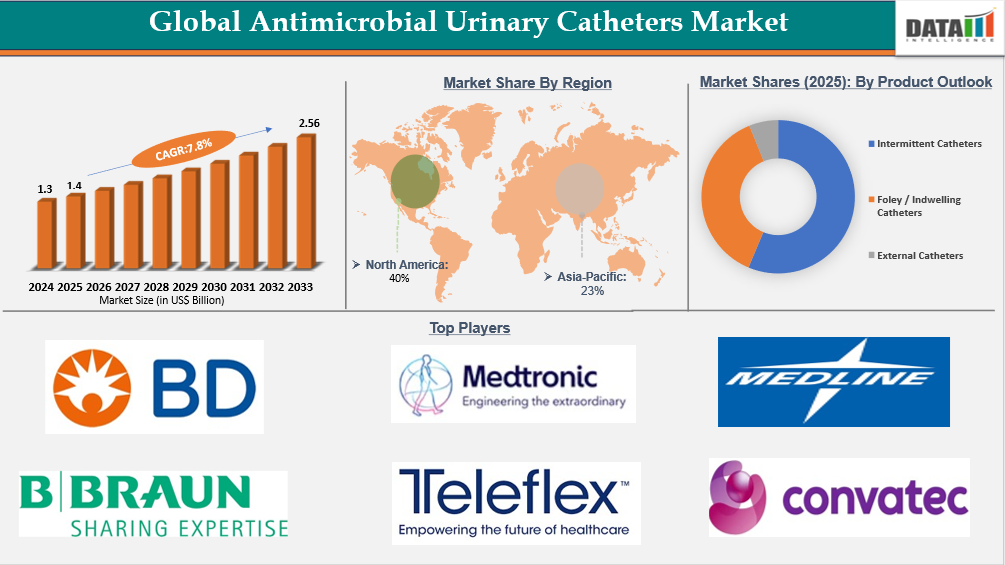
The Global Antimicrobial Urinary Catheters Market is expected to reach at a CAGR of 7.8% during the forecast period 2026 to 2033.
The Antimicrobial Urinary Catheters Market is growing steadily, driven by rising hospital-acquired infections, aging populations, and demand for advanced infection-control medical devices worldwide.”
AUSTIN, TX, UNITED STATES, February 25, 2026 /EINPresswire.com/ -- Market Overview:— DataM Intelligence
The Antimicrobial Urinary Catheters Market has emerged as a critical segment within the broader urology devices and infection prevention landscape. These catheters are designed with antimicrobial coatings such as silver alloy, nitrofurazone, or antibiotic-impregnated materials to reduce the risk of catheter-associated urinary tract infections (CAUTIs). With urinary tract infections (UTIs) among the most common healthcare-associated infections globally, hospitals and long-term care facilities are increasingly adopting antimicrobial-coated urinary catheters to enhance patient safety and reduce healthcare costs. The market is benefiting from rising surgical volumes, a growing geriatric population prone to urinary incontinence, and stricter infection control regulations across healthcare settings.
To Download Sample Report Here: https://www.datamintelligence.com/download-sample/antimicrobial-urinary-catheters-market
According to DataM Intelligence, The Global Antimicrobial Urinary Catheters Market was valued at approximately USD 1.4 billion in 2025 and is projected to reach around USD 2.56 billion by 2033, growing at a CAGR of 7.8% during the forecast period (2026-2033). The key growth drivers include increasing awareness about infection prevention, expanding hospital infrastructure in emerging economies, and technological advancements in catheter materials. The silver alloy-coated catheter segment leads the market due to its proven efficacy in reducing bacterial colonization and biofilm formation. Geographically, North America dominates the market owing to advanced healthcare infrastructure, strong reimbursement policies, and strict infection control guidelines enforced by regulatory authorities.
Key Highlights from the Report:
The Antimicrobial Urinary Catheters Market is projected to grow at a CAGR of 7.8% through 2033.
Silver alloy-coated catheters account for the largest revenue share due to superior antimicrobial properties.
Hospitals represent the leading end-user segment, driven by high surgical admissions and ICU utilization.
North America dominates the global market owing to stringent infection prevention regulations.
Rising prevalence of catheter-associated urinary tract infections (CAUTIs) is fueling product adoption.
Emerging economies in Asia-Pacific are witnessing rapid growth due to expanding healthcare access.
Market Segmentation:
The Antimicrobial Urinary Catheters Market is segmented based on product type, catheter type, end-user, and geography. By product type, the market includes silver-coated catheters, antibiotic-impregnated catheters, and nitrofurazone-coated catheters. Silver-coated catheters dominate the segment due to their broad-spectrum antimicrobial effectiveness and lower resistance risk. These products are widely used in acute care hospitals where infection control protocols are strictly enforced. Antibiotic-coated catheters also hold a significant share, particularly in high-risk patient groups, although concerns about antibiotic resistance slightly limit their widespread adoption.
In terms of catheter type, the market is categorized into Foley catheters, intermittent catheters, and suprapubic catheters. Foley catheters hold the largest share, as they are extensively used for long-term catheterization in surgical procedures and intensive care units. Intermittent catheters are gaining popularity in home healthcare settings due to convenience and reduced infection risk compared to indwelling catheters.
Based on end-user, the market is segmented into hospitals, ambulatory surgical centers (ASCs), long-term care facilities, and home healthcare. Hospitals remain the dominant segment, primarily due to the high incidence of inpatient procedures requiring urinary catheterization. Long-term care facilities are witnessing increasing demand owing to the aging population and chronic disease burden, which often necessitates prolonged catheter use.
Speak to Our Analyst and Get Customization in the report as per your requirements: https://www.datamintelligence.com/customize/antimicrobial-urinary-catheters-market
Regional Insights:
North America leads the Antimicrobial Urinary Catheters Market, supported by robust healthcare infrastructure and proactive infection prevention programs. The United States, in particular, has implemented strict CAUTI reduction initiatives, encouraging hospitals to adopt antimicrobial-coated catheters. Favorable reimbursement frameworks and awareness campaigns further drive product uptake in the region.
Europe holds the second-largest market share, driven by well-established healthcare systems and regulatory standards promoting patient safety. Countries such as Germany, France, and the United Kingdom have integrated infection control protocols into hospital accreditation requirements, thereby stimulating demand for advanced urinary catheter solutions.
The Asia-Pacific region is expected to witness the fastest growth during the forecast period. Rapid urbanization, expanding hospital networks, and increasing healthcare expenditure in countries such as China and India are key contributors. Additionally, rising awareness about hospital-acquired infections and improvements in healthcare infrastructure are accelerating market penetration.
Latin America and the Middle East & Africa are gradually emerging as potential markets. While healthcare budgets may be limited compared to developed regions, investments in modern medical facilities and government initiatives to improve infection control standards are creating new growth opportunities.
Market Dynamics:
Market Drivers
One of the primary drivers of the Antimicrobial Urinary Catheters Market is the increasing prevalence of catheter-associated urinary tract infections. CAUTIs not only prolong hospital stays but also significantly increase healthcare costs and patient morbidity. As hospitals face penalties for high infection rates, the adoption of antimicrobial-coated catheters becomes a strategic measure to mitigate risks. Furthermore, the global rise in surgical procedures and the growing elderly population who are more susceptible to urinary retention and incontinence continue to expand the demand base. Technological innovations in catheter materials, including hydrogel coatings and biocompatible polymers, are also enhancing product performance and patient comfort.
Market Restraints
Despite strong growth prospects, the market faces certain restraints. The higher cost of antimicrobial urinary catheters compared to standard catheters can limit adoption in cost-sensitive healthcare systems. In low- and middle-income countries, budget constraints may restrict widespread usage. Additionally, concerns related to antimicrobial resistance, especially with antibiotic-impregnated catheters, pose regulatory and clinical challenges. Limited awareness in rural healthcare facilities and potential allergic reactions to certain coating materials also hinder market growth.
Market Opportunities
The Market presents substantial opportunities in emerging economies where healthcare infrastructure is rapidly evolving. Expanding medical tourism and increasing investments in private hospitals create a favorable environment for advanced catheter technologies. Moreover, the shift toward home healthcare and outpatient procedures opens new avenues for intermittent antimicrobial catheters. Research and development initiatives focusing on biodegradable and next-generation antimicrobial coatings offer long-term growth potential. Collaborations between manufacturers and healthcare providers to develop cost-effective solutions can further accelerate market expansion.
Looking For Full Report? Get it Here: https://www.datamintelligence.com/buy-now-page?report=antimicrobial-urinary-catheters-market
Frequently Asked Questions (FAQs):
How big is the Global Antimicrobial Urinary Catheters Market in 2026?
What is the projected growth rate of the Antimicrobial Urinary Catheters Market through 2033?
Who are the key players in the Global Antimicrobial Urinary Catheters Market?
What is the market forecast for the Antimicrobial Urinary Catheters Market by 2033?
Which region is estimated to dominate the Antimicrobial Urinary Catheters Market during the forecast period?
Company Insights:
The Antimicrobial Urinary Catheters Market is characterized by the presence of several global and regional players focusing on product innovation and strategic partnerships.
BD
B. Braun Melsungen AG
Medline Industries, L.P.
Coloplast A/S
Medtronic plc
Silq Technologies
Boston Scientific Corporation
Hollister Incorporated
Convatec
Teleflex Incorporated
Recent Developments:
United States:
February 2026: B. Braun introduced a new chlorhexidine-impregnated model compliant with updated Joint Commission standards, emphasizing biocompatibility for elderly patients. Market analysts noted a 6.3% quarterly growth spike driven by this innovation.
January 2026: Teleflex partnered with major US hospital networks for a nationwide rollout of smart antimicrobial catheters integrated with IoT monitoring for real-time infection alerts. This addressed veteran care needs, with VA hospitals reporting preliminary 15% cost savings from reduced readmissions.
December 2025: Coloplast launched an upgraded hydrophilic antimicrobial catheter variant with extended efficacy against multi-drug resistant bacteria, targeting long-term care facilities. Clinical trials showed a 25% reduction in infection rates, boosting Medicare reimbursements for such devices.
November 2025: Leading manufacturers like BD and Teleflex expanded production of antimicrobial-coated urinary catheters to meet rising hospital demand for CAUTI prevention amid stricter CDC infection control guidelines. This followed a surge in healthcare-associated infection reports, prompting faster FDA approvals for next-gen silver-alloy coatings. Home healthcare adoption grew by 8% in response.
Japan:
February 2026: Collaborations between local biotech firms and global players like Teleflex advanced nanocoating trials, projecting 10.5% CAGR through 2033 via improved antimicrobial durability. Elder care facilities led early adoption.
January 2026: Market research highlighted Japan antimicrobial coated urinary catheter sector reaching USD 500 million valuation, fueled by R&D in smart tech integration and PMDA regulatory agility. Hospitals prioritized vendors with proven CAUTI reduction data.
December 2025: A key urology association endorsed wider use of antimicrobial catheters in outpatient settings, citing 5.9% market growth from elderly-driven demand and clinical compliance. This spurred procurement contracts with firms like Asahi Kasei.
November 2025: PMDA approved Toray Industries' advanced silver-carbide coated urinary catheter, enhancing biocompatibility for Japan's aging population. Adoption surged in tertiary hospitals, aligning with national eldercare infection prevention mandates.
Unlock 360° Market Intelligence with DataM Subscription Services: https://www.datamintelligence.com/reports-subscription
Conclusion:
The Antimicrobial Urinary Catheters Market is poised for steady growth, driven by rising concerns over hospital-acquired infections, increasing surgical procedures, and a rapidly aging global population. Silver-coated catheters continue to lead the market due to their effectiveness in reducing bacterial colonization, while hospitals remain the primary end users. North America dominates the global landscape, supported by strong regulatory frameworks and advanced healthcare systems, though Asia-Pacific is emerging as the fastest-growing region. Despite cost-related and resistance challenges, ongoing technological advancements and expanding healthcare infrastructure worldwide position the market for sustained expansion in the coming years.
Related Reports:
Neurovascular Catheters Market
Biliary Catheters Market
Sai Kiran
DataM Intelligence 4Market Research
+1 877-441-4866
Sai.k@datamintelligence.com
Visit us on social media:
LinkedIn
X
Legal Disclaimer:
EIN Presswire provides this news content "as is" without warranty of any kind. We do not accept any responsibility or liability for the accuracy, content, images, videos, licenses, completeness, legality, or reliability of the information contained in this article. If you have any complaints or copyright issues related to this article, kindly contact the author above.
