

3D Cell Culture Market is expected to Hit US$ 4.11 Billion by 2033 | DataM Intelligence
3D Cell Culture Market
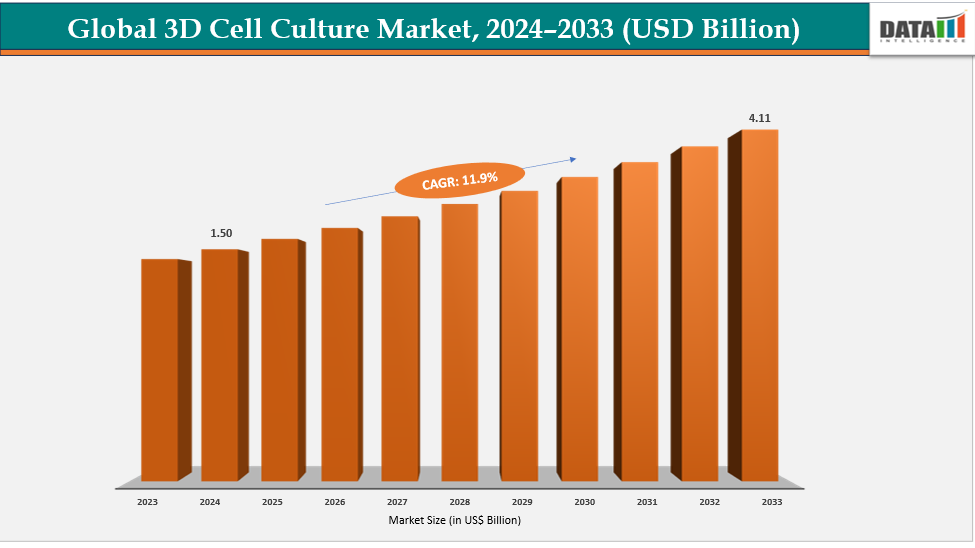
The Global 3D Cell Culture Market is expected to reach at a CAGR of 11.9% during the forecast period 2025-2033.
The 3D Cell Culture Market grows rapidly as biotech advances, enabling realistic tissue models, faster drug discovery, and innovative regenerative medicine solutions.”
AUSTIN, TX, UNITED STATES, February 24, 2026 /EINPresswire.com/ -- Market Overview:— DataM Intelligence
The 3D Cell Culture Market has emerged as a pivotal segment within the biotechnology and pharmaceutical industries, offering a more accurate representation of in vivo cellular environments compared to traditional 2D cultures. Unlike conventional monolayer cultures, 3D cell culture techniques enable cells to grow in all three dimensions, facilitating better modeling of tissue architecture, cell-to-cell interactions, and drug response mechanisms. These advanced systems have proven invaluable for drug discovery, regenerative medicine, cancer research, and tissue engineering, fueling substantial demand for innovative platforms, scaffolds, and reagents tailored for 3D applications.
To Download Sample Report Here: https://www.datamintelligence.com/download-sample/3d-cell-culture-market
According to DataM Intelligence, The Global 3D Cell Culture Market was valued at approximately USD 1.50 billion in 2024 and is projected to reach USD 4.11 billion by 2033, exhibiting a compound annual growth rate (CAGR) of 11.9% during the forecast period. The market’s growth is primarily driven by increasing investments in pharmaceutical research, rising adoption of personalized medicine, and the need for reliable preclinical drug testing models. Scaffold-based 3D cultures currently dominate the market due to their ability to closely mimic native tissue structures. Geographically, North America leads the market, supported by robust R&D infrastructure, strong presence of key biotech companies, and extensive government funding in healthcare innovations.
Key Highlights from the Report:
The Global 3D Cell Culture Market is expected to grow at a CAGR of 11.9% from 2025 to 2033.
Scaffold-based 3D culture systems hold the largest share in the product type segment.
North America remains the leading region, driven by extensive biotech and pharmaceutical research activities.
Increasing adoption of 3D cell culture in drug discovery and toxicology studies fuels market growth.
Regenerative medicine applications are emerging as a major growth opportunity.
Rising collaborations between biotech firms and research institutions enhance technological advancements.
Market Segmentation:
The 3D Cell Culture Market is primarily segmented based on product type, application, and end-user. In terms of product type, the market includes scaffold-based, scaffold-free, and bioreactor-based systems. Scaffold-based systems are preferred for tissue engineering due to their structural support and biocompatibility, while scaffold-free methods, such as spheroids and organoids, are gaining traction for cancer and stem cell research. Bioreactor-based platforms are used extensively in large-scale industrial and pharmaceutical applications for consistent cell growth.
Applications of 3D cell culture span drug discovery and development, toxicology studies, regenerative medicine, and cancer research. Among these, drug discovery dominates as pharmaceutical companies increasingly rely on 3D models to reduce clinical trial failures. End-users are categorized into pharmaceutical and biotechnology companies, academic and research institutes, and contract research organizations (CROs). Pharmaceutical companies lead the market share due to their significant R&D investments and focus on developing advanced therapeutics.
Speak to Our Analyst and Get Customization in the report as per your requirements: https://www.datamintelligence.com/customize/3d-cell-culture-market
Regional Insights:
Regionally, North America dominates the 3D Cell Culture Market, accounting for the largest revenue share. The presence of major players, advanced laboratory infrastructure, and supportive government initiatives in the United States and Canada provide a conducive environment for market expansion. Europe follows closely, with Germany, France, and the U.K. witnessing substantial adoption of 3D cell culture in drug testing and regenerative medicine. The Asia-Pacific region is emerging as a high-growth market due to increasing investments in biotechnology, expanding pharmaceutical manufacturing, and rising awareness of advanced cell culture techniques in countries like China, Japan, and India. Meanwhile, Latin America and the Middle East & Africa remain niche markets, with growth driven by academic research and growing healthcare expenditures.
Market Dynamics:
Market Drivers
The 3D Cell Culture Market is propelled by the need for more physiologically relevant models that replicate human tissue behavior. Pharmaceutical companies are increasingly adopting 3D models to enhance the predictive accuracy of preclinical drug testing, reducing the chances of late-stage failures. Additionally, the growing focus on regenerative medicine and personalized therapy solutions is expanding the demand for organoids, spheroids, and bioprinted tissue models. Technological advancements, such as hydrogel scaffolds, microfluidic devices, and automated bioreactors, further strengthen market growth.
Market Restraints
Despite its promising potential, the 3D cell culture market faces certain challenges. High costs associated with 3D systems, including consumables, equipment, and technical expertise, limit widespread adoption, particularly in emerging markets. Furthermore, standardization issues and the complexity of replicating tissue-specific microenvironments can hinder consistent results. Limited awareness in smaller laboratories and lack of regulatory guidance for commercial applications also pose significant restraints.
Market Opportunities
The market presents lucrative opportunities in the areas of cancer research, stem cell therapies, and drug toxicity testing. Expanding applications in high-throughput screening, organ-on-a-chip technologies, and automated 3D platforms are attracting both startups and established biotech companies. Collaborations between pharmaceutical firms and academic institutions offer opportunities for innovation in scaffold design, culture media optimization, and integrated 3D systems, further accelerating market penetration.
Looking For Full Report? Get it Here: https://www.datamintelligence.com/buy-now-page?report=3d-cell-culture-market
Frequently Asked Questions (FAQs):
How big is the 3D Cell Culture Market in 2026?
Which region is projected to dominate the 3D cell culture market?
Who are the key players in the global 3D cell culture industry?
What is the projected CAGR of the 3D cell culture market through 2033?
How is 3D cell culture impacting drug discovery and regenerative medicine?
Company Insights:
Key players operating in the 3D Cell Culture Market include:
Thermo Fisher Scientific Inc.
Merck
lena biosciences
Corning Incorporated
Sartorius AG
EPROCELL Inc.
Mimetas
CN Bio Innovations Ltd
InSphero
Lonza.
Recent Developments:
United States:
February 2026: A collaboration between U.S. national labs and pharma giants introduced scaffold-free 3D cultures using CRISPR-edited stem cells, boosting precision in gene therapy development.
January 2026: U.S. researchers unveiled a microfluidic 3D cell culture chip integrated with AI analytics, improving real-time disease modeling for neurodegenerative disorders.
December 2025: The FDA approved a novel 3D bioprinting system for tissue engineering applications, marking a milestone in personalized medicine and regenerative therapies.
November 2025: A major U.S. biotech firm launched an advanced 3D organoid platform for oncology drug screening, enhancing tumor microenvironment simulation to accelerate clinical trial success rates.
Japan:
February 2026: Leading Kyoto university partnered with industry to commercialize 3D spheroid arrays for high-throughput antiviral screening, targeting emerging pathogens.
January 2026: Japan's Ministry of Health announced grants for 3D cell culture in aging research, focusing on Alzheimer's models with enhanced blood-brain barrier replication.
December 2025: A Tokyo-based consortium debuted organ-on-a-chip technology mimicking liver metabolism, aiding faster hepatotoxicity testing for new drug candidates.
November 2025: Japanese iPSC pioneers released a proprietary 3D culture protocol for cardiac tissue regeneration, supported by government funding under Society 5.0 initiatives.
Unlock 360° Market Intelligence with DataM Subscription Services: https://www.datamintelligence.com/reports-subscription
Conclusion:
The 3D Cell Culture Market is poised for significant growth, driven by its ability to bridge the gap between conventional 2D models and in vivo systems. With advancements in scaffolds, bioreactors, and organoid technologies, the market is witnessing increasing adoption across pharmaceuticals, academia, and biotech industries. North America continues to lead due to robust R&D infrastructure, while Asia-Pacific emerges as a promising high-growth region. Market dynamics highlight strong drivers in drug discovery and regenerative medicine, countered by challenges like high costs and standardization issues. Nevertheless, innovations and collaborations among leading players are expected to propel the market toward greater technological integration and global adoption, creating substantial opportunities for investors and researchers alike.
Related Reports:
Cell Dissociation Market
Cell Signaling Market
Sai Kiran
DataM Intelligence 4Market Research
+1 877-441-4866
Sai.k@datamintelligence.com
Visit us on social media:
LinkedIn
X
Legal Disclaimer:
EIN Presswire provides this news content "as is" without warranty of any kind. We do not accept any responsibility or liability for the accuracy, content, images, videos, licenses, completeness, legality, or reliability of the information contained in this article. If you have any complaints or copyright issues related to this article, kindly contact the author above.
