

Electronic-Grade Isopropyl Alcohol Market to Reach USD 2.0 Billion by 2036 on Semiconductor Demand
Electronic-Grade Isopropyl Alcohol (IPA) Market
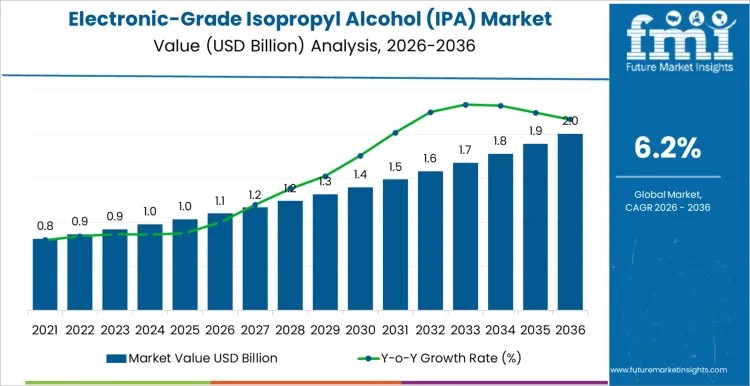
Global electronic-grade IPA market grows from USD 1.1B in 2026 to USD 2.0B by 2036, driven by ultra-clean semiconductor manufacturing needs.
NEWARK, DE, UNITED STATES, January 19, 2026 /EINPresswire.com/ -- The global electronic-grade isopropyl alcohol (IPA) market is projected to grow from USD 1.1 billion in 2026 to USD 2.0 billion by 2036, expanding at a compound annual growth rate (CAGR) of 6.20%. Growth is being driven by rising demand from semiconductor fabrication, display manufacturing, and advanced electronics assembly, where ultra-high-purity solvents are essential for contamination control and yield optimization.
Request For Sample Report | Customize Report |purchase Full Report - https://www.futuremarketinsights.com/reports/sample/rep-gb-31515
Market Context: Why Electronic-Grade IPA Matters in Advanced Manufacturing
Electronic-grade IPA is a critical consumable in semiconductor wafer cleaning, photoresist removal, surface preparation, and drying processes. As device architectures become more complex and feature sizes shrink, even trace levels of water, metals, or organic contaminants can reduce yields and compromise reliability. This has intensified reliance on solvents that meet extremely tight impurity thresholds and deliver consistent, residue-free performance.
Supply performance in this market is shaped more by production concentration and quality control capability than by sheer capacity scale. Manufacturing is limited to suppliers capable of sustaining ultra-high purity through dedicated distillation, advanced filtration, and contamination-controlled packaging systems. Proximity to semiconductor fabs has become strategically important, reducing logistics risk and enabling synchronized production planning.
Key Market Metrics at a Glance
• Market Value (2026): USD 1.1 Billion
• Forecast Value (2036): USD 2.0 Billion
• CAGR (2026–2036): 6.20%
• Leading Purity Level: >99.99% electronic grade
• Leading Application: Semiconductor wafer cleaning (40% share)
• Top Growth Regions: Asia Pacific, Europe, North America
• Key Players: Mitsubishi Chemical Group, LCY Chemical Corp., Tokuyama Corporation, LG Chem Ltd., Linde plc, ExxonMobil Chemical, Dow Chemical Company, Shell Chemicals, INEOS Group, Clean Science and Technology Ltd.
Why >99.99% Electronic-Grade IPA Leads the Market
The >99.99% purity segment accounts for approximately 54% of total market share, reflecting the stringent requirements of advanced semiconductor processes. This grade is essential for final rinse and drying steps, where any residue can introduce defects. High-volume wafer production further amplifies demand for the highest purity IPA, as consistent solvent quality becomes critical for maintaining tight process windows.
Suppliers are investing in multi-stage distillation, closed-handling systems, and advanced analytical verification to ensure batch-to-batch consistency. Procurement decisions increasingly prioritize metal ion content, moisture levels, and filtration standards, positioning purity assurance as a primary competitive differentiator.
Semiconductor Wafer Cleaning Remains the Dominant Application
Semiconductor wafer cleaning represents 40% of total electronic-grade IPA consumption. IPA is used repeatedly across multiple fabrication stages for particle removal and surface preparation. Its rapid evaporation rate and residue-free behavior make it particularly well-suited for high-throughput automated cleaning operations.
As chip architectures grow more complex, sensitivity to surface contamination continues to increase. This reinforces reliance on high-purity IPA, especially in leading-edge fabs where cleaning frequency and solvent volumes are rising in parallel with process complexity.
Regional Growth Patterns Reflect Fab Expansion and Localization
• China: CAGR of 7.4% (2026–2036), driven by domestic fab expansion, display panel manufacturing, and localization of electronic chemicals supply.
• Brazil: CAGR of 7.0%, supported by growth in electronics assembly, optoelectronics, and precision component cleaning.
• United States: CAGR of 5.9%, reflecting renewed investment in domestic semiconductor capacity and advanced node production.
• Germany: CAGR of 5.8%, driven by demand from power semiconductors, automotive electronics, and industrial electronics.
• South Korea: CAGR of 5.4%, supported by memory semiconductor manufacturing and OLED display production.
Across regions, buyers emphasize purity certification, stable supply, and compatibility with automated wet processing systems. Regional proximity to fabs is increasingly viewed as a strategic advantage, enabling tighter logistics control and faster response times.
Competitive Landscape: Purity, Reliability, and Integration Define Advantage
Competition in the electronic-grade IPA market centers on ultra-high purity, trace contaminant control, and supply chain reliability rather than price alone. Mitsubishi Chemical Group and LCY Chemical Corp. emphasize rigorous purification and extensive impurity testing. Tokuyama Corporation and LG Chem Ltd. focus on aligning solvent quality with stringent semiconductor fabrication specifications.
Global producers such as Linde plc, ExxonMobil Chemical, Dow Chemical Company, Shell Chemicals, and INEOS Group leverage scale, logistics integration, and analytical traceability. Clean Science and Technology Ltd. differentiates through niche ultra-high-purity IPA grades with verified low metals and moisture content.
Long qualification cycles and validation requirements at semiconductor fabs continue to favor established suppliers, reinforcing market concentration and predictable utilization patterns.
Outlook: Supply Assurance and Quality Control Will Shape the Next Decade
As semiconductor manufacturing becomes more geographically distributed, localized production control and supply assurance are expected to remain central to market performance. Expanding fab capacity, tightening contamination standards, and rising solvent consumption per wafer will continue to support growth through 2036.
For producers, competitive positioning will depend on sustained investments in purification infrastructure, quality assurance systems, and regional supply networks. For end users, long-term contracts and supplier collaboration will remain key strategies for managing operational risk in an increasingly precision-driven manufacturing environment.
Browse Related Insights
Clay Based Construction Products Market https://www.futuremarketinsights.com/reports/clay-based-construction-products-market
Nannochloropsis Market https://www.futuremarketinsights.com/reports/nannochloropsis-market
Butane Market https://www.futuremarketinsights.com/reports/butane-market
Aerosol Propellants Market https://www.futuremarketinsights.com/reports/aerosol-propellants-market
About Future Market Insights (FMI)
Future Market Insights, Inc. (FMI) is an ESOMAR-certified, ISO 9001:2015 market research and consulting organization, trusted by Fortune 500 clients and global enterprises. With operations in the U.S., UK, India, and Dubai, FMI provides data-backed insights and strategic intelligence across 30+ industries and 1200 markets worldwide.
Sudip Saha
Future Market Insights Inc.
+1 347-918-3531
email us here
Legal Disclaimer:
EIN Presswire provides this news content "as is" without warranty of any kind. We do not accept any responsibility or liability for the accuracy, content, images, videos, licenses, completeness, legality, or reliability of the information contained in this article. If you have any complaints or copyright issues related to this article, kindly contact the author above.
