

NI Facilities Expert Outlines Key Compliance Requirements for Legionella, Ventilation Hygiene and Electrical Safety
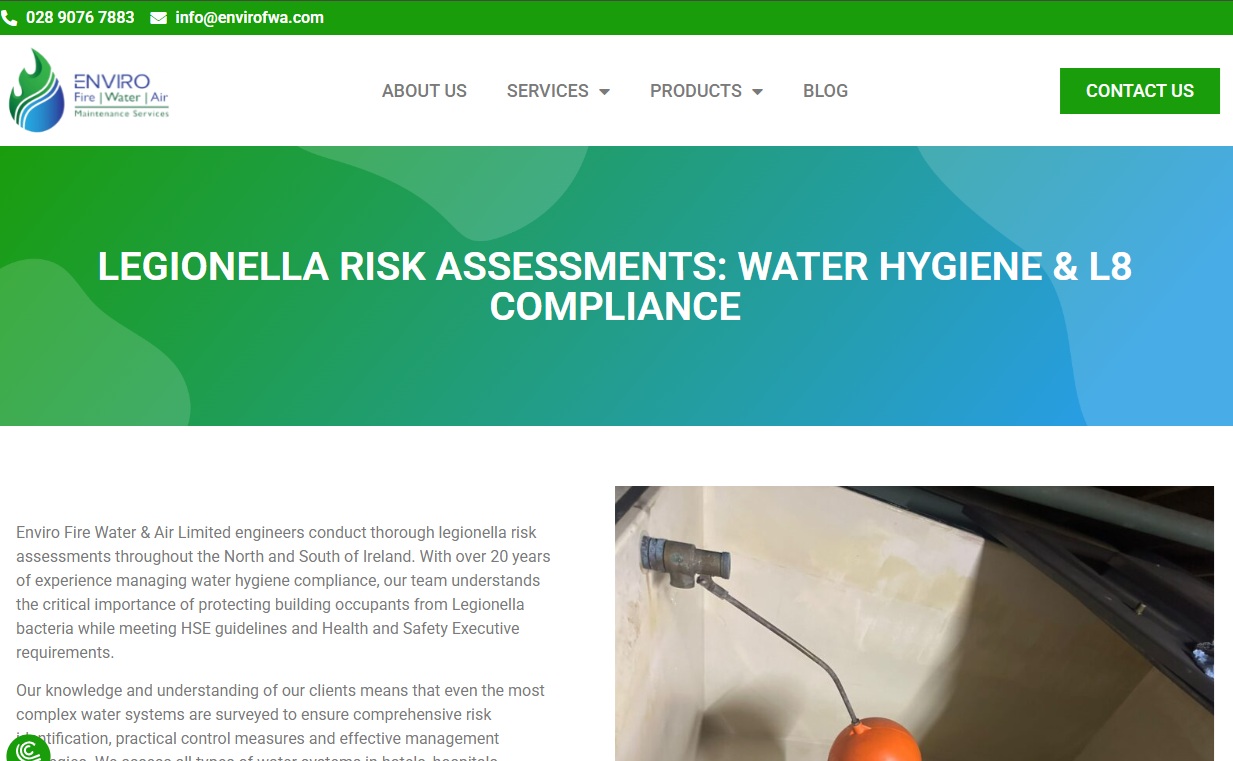
Enviro FWA delivers comprehensive facilities management and compliance services across Ireland.
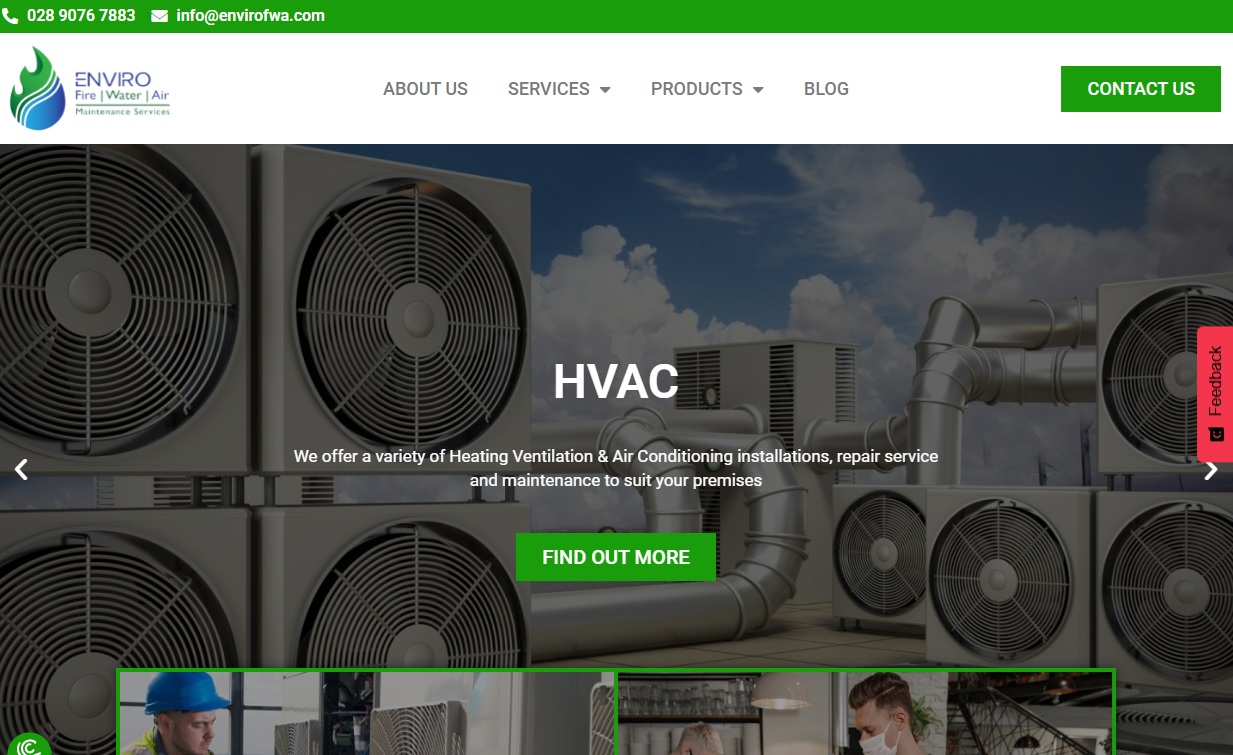
HVAC maintenance to solar installations, legionella assessments to PAT testing
Enviro Fire Water & Air responds to increased demand for legionella management, ventilation hygiene and renewable energy services across Ireland
WARRENPOINT, COUNTY DOWN, UNITED KINGDOM, January 2, 2026 /EINPresswire.com/ -- As businesses across Northern Ireland and Ireland plan for 2026, facilities compliance remains a priority area requiring attention. From water safety obligations to fire prevention measures and energy efficiency targets, commercial premises face a range of regulatory requirements that demand proper management. Enviro Fire Water & Air Limited, a Warrenpoint-based HVAC and facilities maintenance company with over 20 years of industry experience, has outlined the key compliance areas that businesses should address in the year ahead. The company works across multiple sectors including education, healthcare, hospitality, commercial and industrial premises, leisure and retail, and government facilities throughout Belfast, Newry, Dublin, Coleraine, Ballymena, Lisburn, Newcastle, Louth and Monaghan.Water Safety: Legionella Risk Management Requirements
Legionella control remains one of the most important compliance obligations for businesses operating commercial premises. The Health and Safety Executive for Northern Ireland requires all employers and those in control of premises to assess and manage legionella risks under the Control of Substances Hazardous to Health Regulations (Northern Ireland) 2003. Equivalent requirements apply in the Republic of Ireland under the Safety, Health and Welfare at Work Act 2005.
Legionella bacteria occur naturally in water sources but can multiply to dangerous levels in building water systems where conditions allow. Hot and cold water systems, cooling towers, spa pools, showers and other water-based equipment can all present risks if not properly managed. The bacteria cause Legionnaires' disease, a serious and potentially fatal form of pneumonia contracted by inhaling contaminated water droplets.
The L8 Approved Code of Practice sets out the framework for legionella control in the UK, while the National Guidelines for the Control of Legionellosis provide equivalent guidance in Ireland. Both require duty holders to appoint a responsible person, conduct risk assessments, implement control schemes and maintain proper records.
"Every organisation with a water system needs a documented risk assessment and a control plan that is reviewed regularly," said a spokesperson for Enviro FWA. "The responsible person must ensure that appropriate control measures are in place and that records are maintained. This is a legal requirement, not a recommendation."
Key actions for businesses in 2026 include reviewing existing legionella risk assessments, ensuring assessments are no more than two years old, checking that control measures are being implemented correctly, and verifying that monitoring records are up to date. Premises that have been unoccupied for extended periods, undergone alterations, or experienced changes in use should arrange fresh assessments.
Healthcare facilities, care homes, hotels, leisure centres and other premises serving vulnerable populations face heightened requirements. These settings typically require annual risk assessment review and more stringent ongoing monitoring programmes.
Enviro FWA provides legionella risk assessments, cold water tank cleaning, water quality analysis, temperature monitoring and remedial works for businesses across Ireland. Businesses should be aware that regulations, standards and grant schemes may change during 2026, so it is important to seek up‑to‑date professional advice and check the latest official guidance before making decisions.
Fire Safety: Kitchen Extraction and Ventilation Hygiene
Commercial kitchens face specific fire safety obligations related to extraction system maintenance. Grease accumulation in kitchen ventilation systems presents a significant fire risk that building operators must actively manage.
When cooking produces grease-laden vapours, residue builds up in filters, canopies, ductwork, fans and other components of the extraction system. This accumulated grease can ignite if exposed to high temperatures, and fires can spread rapidly through ductwork to affect other parts of a building. Insurers increasingly require evidence of regular professional cleaning to maintain cover for commercial kitchen operations.
TR19 is the industry specification developed by the Building Engineering Services Association for the internal cleanliness of ventilation systems. The standard sets measurable cleanliness criteria and requires proper documentation of cleaning work. Insurance providers and fire safety inspectors recognise TR19 compliance as evidence that extraction systems have been professionally maintained to an appropriate standard.
The Building Engineering Services Association manages the Vent Hygiene Register, which verifies the competence of contractors carrying out ventilation cleaning work. The register is recognised by the insurance fire risk body RISCAuthority and by the London Fire Brigade, which has updated its guidance for catering premises to reference TR19 standards.
Cleaning frequency depends on cooking volume, the type of food being prepared and kitchen operating hours. High-volume commercial kitchens producing significant amounts of grease-laden cooking may require monthly cleaning. Medium-use kitchens might need quarterly cleaning, while lower-use establishments could operate safely with six-monthly schedules.
Fire damper testing represents another important fire safety consideration. Fire dampers are safety devices installed in ductwork where it passes through fire-resistant walls and floors. When activated by heat or smoke detection systems, fire dampers close to prevent fire and smoke spreading through ventilation systems. Regular testing ensures these critical safety devices function correctly when needed.
Businesses should review their kitchen extraction cleaning schedules, check that cleaning contractors hold appropriate accreditations, ensure post-clean documentation is being provided and retained, and verify that fire dampers are being tested at appropriate intervals.
Enviro FWA operates as a BESCA Elite Member for ventilation hygiene services, meeting TR19 standards for grease extract system cleaning. The company provides canopy cleaning, ductwork cleaning, filter maintenance, grease trap servicing and fire damper testing.
Electrical Safety: PAT Testing and Fixed Wire Inspection
Electrical safety compliance requires attention to both portable equipment and fixed installations. Faulty electrical equipment and installations can cause fires, electric shocks and other serious incidents, making regular testing an important part of workplace safety management.
Portable Appliance Testing examines electrical equipment that connects to the mains supply via a plug. The testing process includes visual inspection for damage, wear and incorrect wiring, along with electrical tests to check insulation resistance, earth continuity and other safety parameters.
Testing frequency depends on the type of equipment and the environment where it is used. The Health and Safety Executive provides guidance on recommended testing intervals. Office equipment in low-risk environments typically requires annual testing. Equipment used in harsher conditions, moved frequently, or used by the public may require more frequent testing. Industrial, construction and hospitality environments often require testing every three to six months.
Fixed wire testing, also known as periodic inspection and testing or EICR (Electrical Installation Condition Report), examines the permanent electrical installation in a building. This includes distribution boards, wiring, switches, sockets and fixed equipment.
Commercial premises typically require fixed wire testing every five years, though some environments require more frequent inspection. The testing produces a detailed report identifying any defects and classifying them by severity. Building owners and occupiers use this information to prioritise remedial work and maintain safe electrical installations.
Businesses entering 2026 should check when PAT testing was last carried out, review whether testing frequency matches the risk level of their environment, verify when fixed wire testing was last completed, and address any outstanding remedial items from previous inspection reports.
Enviro FWA provides PAT testing and fixed wire testing services along with extractor fan repair and replacement for commercial premises.
HVAC Compliance: F-Gas Regulations and System Maintenance
Businesses operating air conditioning and refrigeration equipment face ongoing compliance obligations under F-Gas regulations. These regulations control the use of fluorinated greenhouse gases, which are commonly used as refrigerants.
F-Gas certified engineers must carry out installation, maintenance and decommissioning of equipment containing controlled refrigerants. The regulations require leak checking of equipment above certain capacity thresholds, proper recovery of refrigerants during servicing, and maintenance of detailed records.
Equipment operators must ensure that only certified personnel work on their systems and that proper documentation is maintained. Records should include details of refrigerant quantities, leak checks carried out, and any refrigerant added or recovered during servicing.
The phase-down of high global warming potential refrigerants continues to affect the availability and cost of certain gases. Businesses operating older equipment using refrigerants subject to phase-down should consider long-term planning for system replacement or conversion.
Regular maintenance helps maintain equipment efficiency and reliability while ensuring compliance with regulatory requirements. Planned maintenance programmes typically include filter cleaning, refrigerant system checks, electrical testing and general inspection.
Businesses should verify that maintenance contractors hold current F-Gas certification, check that equipment records are complete and up to date, review whether any systems use refrigerants subject to phase-down restrictions, and consider planned maintenance arrangements for critical equipment.
Enviro FWA provides air conditioning and refrigeration installation, maintenance and emergency callout services with full F-Gas compliance.
Energy Efficiency: Renewable Energy Options for Business
Energy costs and carbon reduction targets continue to drive business interest in renewable energy solutions. Several options are available for commercial premises looking to reduce grid electricity consumption and improve energy performance.
Solar photovoltaic systems generate electricity from daylight, providing on-site renewable generation. Solar panels work effectively in Ireland's climate, generating electricity throughout the year with higher output during longer summer days. System output on overcast days is lower than in direct sunlight but still contributes useful generation.
The Sustainable Energy Authority of Ireland operates grant programmes supporting commercial solar installations. The Non-Domestic Microgeneration Scheme provides grant support for installations up to 1MW capacity, with tiered support levels for different system sizes. Businesses should check current grant availability and requirements directly with SEAI, as scheme details are subject to change.
Air source heat pumps offer a renewable heating option for commercial premises. These systems extract heat from outdoor air to provide space heating and hot water, operating efficiently even in cold conditions. Heat pumps can reduce heating costs and carbon emissions compared to traditional fossil fuel systems.
Electric vehicle charging infrastructure is becoming an increasingly common requirement for commercial premises. Whether for company fleet vehicles, employee charging facilities or customer amenities, workplace charging supports the transition to electric transport. Charging points can be integrated with solar PV systems to maximise use of on-site renewable generation.
Businesses considering renewable energy investment should assess site suitability, investigate available grant support, consider different financing options, and evaluate integration with existing building systems.
Enviro FWA provides solar PV installation, air source heat pump retrofitting and EV charging point installation for commercial clients. The company offers outright purchase, asset finance and Power Purchase Agreement options for solar installations.
Multi-Sector Compliance Considerations
Different sectors face specific compliance requirements beyond the general obligations outlined above.
Healthcare and clinical facilities require enhanced legionella control measures due to the vulnerability of patient populations. Water systems in healthcare settings typically need more frequent monitoring and more stringent temperature control. Ventilation systems in clinical areas must meet specific standards for air quality and filtration.
Educational institutions must manage compliance across diverse building types and usage patterns. School holidays create periods when water systems may stagnate, requiring appropriate flushing procedures. Kitchen facilities serving students need proper extraction system maintenance. Electrical testing must cover equipment used by pupils as well as staff.
Hospitality businesses face particular scrutiny from environmental health officers and insurers. Kitchen extraction cleaning documentation may be requested during inspections. Legionella control in guest accommodation requires attention to showers, spa facilities and other water systems. Refrigeration reliability directly affects food safety compliance.
Food manufacturing and processing facilities operate under strict hygiene requirements that affect HVAC system maintenance. Temperature control throughout production and storage areas must be maintained and documented. Ventilation systems require cleaning approaches that avoid contamination risks.
Retail and leisure premises must balance compliance requirements with operational demands. Systems serving public areas require reliable performance. Maintenance scheduling must minimise disruption to trading hours.
Planning for Compliance in 2026
Effective compliance management requires a systematic approach rather than reactive responses to problems or inspections. Businesses benefit from maintaining clear records of all compliance activities, scheduling regular reviews of key obligations, working with qualified contractors who understand regulatory requirements, and addressing identified issues promptly rather than allowing them to accumulate.
A compliance calendar helps track when assessments, tests and maintenance activities fall due. This prevents obligations being overlooked and allows work to be scheduled at convenient times rather than arranged urgently when deadlines approach.
Documentation should be organised so that evidence of compliance can be readily produced if requested by inspectors, insurers or other parties. Digital record systems can help manage this information efficiently.
Contractor selection matters for compliance-critical work. Businesses should verify that contractors hold relevant accreditations, employ properly qualified personnel, provide appropriate documentation, and carry adequate insurance cover.
"We see ourselves as an extension of our clients' businesses," said an Enviro FWA spokesperson. "When they need maintenance support or compliance expertise, we work around their operational hours so there is no disruption. Building long-term relationships means we understand each client's premises and can help them stay ahead of their obligations."
Frequently Asked Questions
How often should a legionella risk assessment be carried out?
Legionella risk assessments should be reviewed at least every two years under normal circumstances. More frequent review is required if there are changes to the water system, alterations to the building, changes in building use, or if the premises have been unoccupied for extended periods. Healthcare facilities and premises serving vulnerable populations typically require annual assessments and more stringent ongoing monitoring.
What is TR19 and why does it matter for commercial kitchens?
TR19 is the industry specification developed by the Building Engineering Services Association for the internal cleanliness of ventilation systems. The standard sets measurable cleanliness criteria and requires proper documentation of cleaning work. Compliance with TR19 demonstrates that grease extract systems have been cleaned to a recognised standard, which helps satisfy insurance requirements, provides evidence of due diligence and reduces fire risk.
Who is legally responsible for legionella control in a workplace?
The duty holder or responsible person for the premises holds legal responsibility for legionella control. This is typically the employer, building owner or landlord who manages or controls the water systems. Under COSHH regulations in Northern Ireland and equivalent legislation in the Republic of Ireland, duty holders must ensure risks are assessed, control measures implemented and proper records maintained.
What grants are available for commercial solar installation in Ireland?
The SEAI Non-Domestic Microgeneration Scheme provides grant support for commercial solar installations up to 1MW capacity. Grant values depend on system size, with tiered support levels for different installation sizes. Businesses should apply through SEAI and receive approval before installation work begins. Grant availability and values are subject to change, so current information should be checked directly with SEAI.
How often do kitchen extraction systems need cleaning?
Cleaning frequency depends on cooking volume, the type of food being prepared and kitchen operating hours. High‑usage commercial kitchens often require cleaning at least every three months, and in some very heavy‑use environments monthly cleaning may be appropriate. Medium‑use kitchens are typically cleaned every three to six months, while lower‑use establishments may operate safely with six‑monthly or annual schedules, subject to a TR19‑based risk assessment.
Paul Devenny
Enviro FWA
email us here
Visit us on social media:
LinkedIn
Instagram
Facebook
Legal Disclaimer:
EIN Presswire provides this news content "as is" without warranty of any kind. We do not accept any responsibility or liability for the accuracy, content, images, videos, licenses, completeness, legality, or reliability of the information contained in this article. If you have any complaints or copyright issues related to this article, kindly contact the author above.
